articles in 2023
all / 2026 / 2025 / 2024 / 2023 / 2022 / 2021 / 2020 / 2019 / 2018 / 2017 / 2016 / 2015 / 2014 / 2013 / 2012 / 2011 / 2010 / 2009 / 2008 / 2007 / 2006 / 2005 / 2004 / 2003 / 2002 / 2001 / 2000 / 1999 / 1998 / 1997 / 1996 / 1995 / 1994 / 1993
-
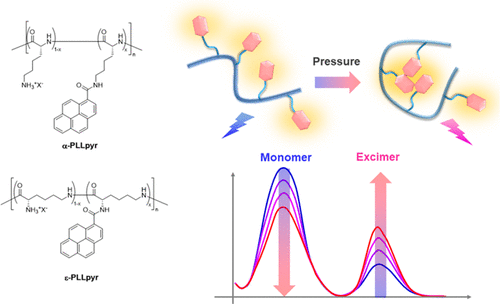 Pressure-responsive polymer chemosensors for hydrostatic-pressure-signal detection: poly-L-lysine–pyrene conjugatesSoshi Wakako, Yumiko Hori, Tomokazu Kinoshita, Takao Saiki, Xinyi Qi, Koki Hasegawa, Yoshitane Imai, Tadashi Mori, Keiichi Nakagawa, and Gaku Fukuhara*ACS Macro Lett., 2023, 12, 1389–1395.
Stimulus-responsive polymer materials are an attractive alternative to conventional supramolecular and polymer assemblies for applications in sensing, imaging, and drug-delivery systems. Herein, we synthesized a series of pyrene-labeled α- and ε-poly-l-lysine conjugates with varying degrees of substitution (DSs). Hydrostatic-pressure-UV/vis, fluorescence, and excitation spectroscopies and fluorescence lifetime measurements revealed ground-state conformers and excited-state ensembles emitting fluorescence with variable intensities. The polylysine-based chemosensors demonstrated diverse ratiometric responses to hydrostatic pressure through adjustments in polar solvents, DSs, and polymer backbones. Additionally, the fluorescence chemosensor exhibited a promising glum value of 3.2 × 10⁻³, indicating potential applications in chiral fluorescent materials. This study offers valuable insights into the development of smart hydrostatic-pressure-responsive polymer materials.
@article{wakako2023pressure, title = {Pressure-responsive polymer chemosensors for hydrostatic-pressure-signal detection: poly-L-lysine--pyrene conjugates}, author = {Wakako, Soshi and Hori, Yumiko and Kinoshita, Tomokazu and Saiki, Takao and Qi, Xinyi and Hasegawa, Koki and Imai, Yoshitane and Mori, Tadashi and Nakagawa, Keiichi and Fukuhara, Gaku}, journal = {ACS Macro Lett.}, volume = {12}, number = {10}, pages = {1389--1395}, year = {2023}, publisher = {ACS Publications}, doi = {10.1021/acsmacrolett.3c00427}, url = {https://doi.org/10.1021/acsmacrolett.3c00427}, dimensions = {true}, tab = {paper}, } -
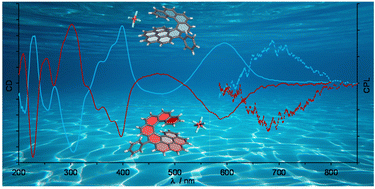 A π-extended phenanthrene-fused aza [7] helicenium as a novel chiroptically-active architecture in organic and aqueous mediaCéline Olivier*, Nao Nagatomo, Tadashi Mori, Nathan McClenaghan, Gediminas Jonusauskas, Brice Kauffmann, Yutaka Kuwahara, Makoto Takafuji, Hirotaka Ihara, and Yann Ferrand*Org. Chemi. Front., 2023, 10, 752–758.
The synthesis and characterization of an original π-extended cationic azahelicene is reported. The phenanthrene-fused aza[7]helicene derivative encompasses a total of ten aromatic fused rings leading to a dissymmetric yet helically folded structure, as revealed by NMR and X-ray diffraction analyses. The polyaromatic and cationic nature of the new azahelicenium makes it soluble in both organic and aqueous media, which allowed photophysical studies in solvents of different polarities. The extended chromophoric species demonstrates a broad absorption over the whole visible range and orange-red fluorescence emission. Chiral resolution of the racemate was performed subsequently, affording two optically pure and configurationally stable azahelicenium enantiomers. Multi-band circular dichroism and long-wavelength circularly polarized emission were observed, associated with remarkable absorption and luminescence dissymmetry factors, both in organic and aqueous media.
@article{olivier2023pi, title = {A π-extended phenanthrene-fused aza [7] helicenium as a novel chiroptically-active architecture in organic and aqueous media}, author = {Olivier, Céline and Nagatomo, Nao and Mori, Tadashi and McClenaghan, Nathan and Jonusauskas, Gediminas and Kauffmann, Brice and Kuwahara, Yutaka and Takafuji, Makoto and Ihara, Hirotaka and Ferrand, Yann}, journal = {Org. Chemi. Front.}, volume = {10}, number = {3}, pages = {752--758}, year = {2023}, publisher = {Royal Society of Chemistry}, doi = {10.1039/d2qo01942f}, url = {https://doi.org/10.1039/d2qo01942f}, dimensions = {true}, tab = {paper}, } -
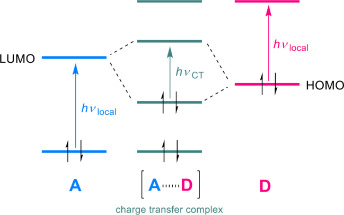 Induction of chirality in the charge transfer complex photochemistryTadashi Mori*J. Photochem. Photobiol., 2023, 17, 100200.
Electron donor and acceptor undergo association in solution to form a weak molecular complex, namely a charge transfer complex. The formation of the complex is apparent by its new low-energy absorption band. Upon photoexcitation of this charge transfer band, an intracomplex electron transfer is facilitated to form a contact ion radical pair. The theoretical basis for the complex formation and the subsequent photoinduced electron transfer process has been well established already half a century ago. Nevertheless, the charge transfer complex photochemistry is now in a renaissance, due to its synthetic utility of its radical ion pair. By intentionally sidestepped unproductive back electron transfer process, a desired product is effectively obtained with or without external reagent and/or catalyst. In addition, the photoexcitation of the complex does not require any additional photocatalyst and often conceivable with the visible light. Accordingly, various donor/acceptor pairs and synthetic applications have been emerged as novel photoreaction systems in the last two decades. Some have also addressed the stereoselective transformations. This mini review highlights the recent progress of the asymmetric photoreaction, in particular in synthetic applications, based on the photoexcitation of the charge transfer complex, in comparison with photoredox catalysis.
@article{mori2023induction, title = {Induction of chirality in the charge transfer complex photochemistry}, author = {Mori, Tadashi}, journal = {J. Photochem. Photobiol.}, volume = {17}, pages = {100200}, year = {2023}, publisher = {Elsevier}, doi = {10.1016/j.jpap.2023.100200}, url = {https://doi.org/10.1016/j.jpap.2023.100200}, dimensions = {true}, tab = {paper}, } -
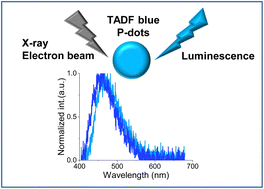 Radioluminescence from polymer dots based on thermally activated delayed fluorescenceDaiki Asanuma, Hieu Thi Minh Nguyen, Zuoyue Liu, Sachiko Tojo, Hajime Shigemitsu, Minoru Yamaji, Kiyohiko Kawai, Tadashi Mori, Toshiyuki Kida, Guillem Pratx*, Mamoru Fujitsuka*, and Yasuko Osakada*Nanoscale Adv., 2023, 5, 3424–3427.
We demonstrate that polymer dots doped with thermally activated delayed fluorescence (TADF) molecules clearly exhibit blue radio-luminescence upon hard X-ray and electron beam irradiation, which is a new design for nano-sized scintillators.
@article{asanuma2023radioluminescence,
  title = {Radioluminescence from polymer dots based on thermally activated delayed fluorescence},
  author = {Asanuma, Daiki and Nguyen, Hieu Thi Minh and Liu, Zuoyue and Tojo, Sachiko and Shigemitsu, Hajime and Yamaji, Minoru and Kawai, Kiyohiko and Mori, Tadashi and Kida, Toshiyuki and Pratx, Guillem and Fujitsuka, Mamoru and Osakada, Yasuko},
  journal = {Nanoscale Adv.},
  volume = {5},
  number = {13},
  pages = {3424--3427},
  year = {2023},
  publisher = {Royal Society of Chemistry},
  doi = {10.1039/d3na00308f},
  url = {https://doi.org/10.1039/d3na00308f},
  dimensions = {true},
  tab = {paper},
}