Exciplex Ensemble Modulated by Excitation Mode in Intramolecular Charge-Transfer Dyad: Effects of Temperature, Solvent Polarity, and Wavelength on Photochemistry and Photophysics of Tethered Naphthalene–Dicyanoethene System
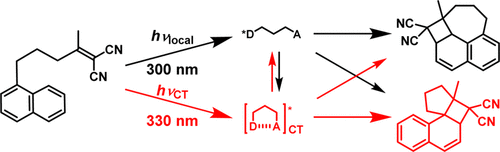
Solvent, temperature, and excitation wavelength significantly affected the photochemical outcomes of a naphthalene–dicyanoethene system tethered by different number (n) of methylene groups (1–3). The effect of irradiation wavelength was almost negligible for 2a but pronounced for 3a. The temperature dependence and theoretical calculations indicated the diversity of exciplex conformations, an ensemble of which can be effectively altered by changing excitation wavelength to eventually switch the regioselectivity of photoreactions.
@article{aoki2014exciplex,title={Exciplex Ensemble Modulated by Excitation Mode in Intramolecular Charge-Transfer Dyad: Effects of Temperature, Solvent Polarity, and Wavelength on Photochemistry and Photophysics of Tethered Naphthalene--Dicyanoethene System},author={Aoki, Yoshiaki and Matsuki, Nobuo and Mori, Tadashi and Ikeda, Hiroshi and Inoue, Yoshihisa},journal={Org. Lett.},volume={16},number={18},pages={4888--4891},year={2014},publisher={ACS Publications},doi={10.1021/ol502394g},url={https://doi.org/10.1021/ol502394g},dimensions={true},tab={paper},}
C-5-Symmetric chiral corannulenes: desymmetrization of bowl inversion equilibrium via “intramolecular” hydrogen-bonding network
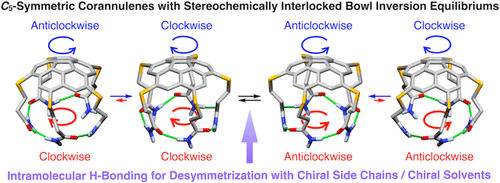
Because of a rapid conformational inversion, bowl-shaped C5-symmetric corannulenes, though geometrically chiral, have not been directly resolved into their enantiomers. However, if this inversion equilibrium can be desymmetrized, chiral corannulenes enriched in either enantiomer can be obtained. We demonstrated this possibility using pentasubstituted corannulenes 4 and 5 carrying amide-appended thioalkyl side chains. Compound 4 displays chiroptical activity in a chiral hydrocarbon such as limonene. Because compound 5 carries a chiral center in the side chains, its enantiomers 5R and 5S show chiroptical activity even in achiral solvents such as CHCl3 and methylcyclohexane. In sharp contrast, when the side chains bear no amide functionality (1 and 2R), no chiroptical activity emerges even in limonene or with a chiral center in the side chains. Detailed investigations revealed that the peripheral amide units in 4 and 5 are hydrogen-bonded only “intramolecularly” along the corannulene periphery, affording cyclic amide networks with clockwise and anticlockwise geometries. Although this networking gives rise to four stereoisomers, only two, which are enantiomeric to one another, are suggested computationally to exist in the equilibrated system. In a chiral environment (chiral solvent or side chain), their thermodynamic stabilities are certainly unequal, so the bowl-inversion equilibrium can be desymmetrized. However, this is not the case when the system contains a protic solvent that can deteriorate the hydrogen-bonding network. When the enantiomeric purity of limonene as the solvent is varied, the chiroptical activity of the corannulene core changes nonlinearly with its enantiomeric excess (majority rule).
@article{kang2014c,title={C-5-Symmetric chiral corannulenes: desymmetrization of bowl inversion equilibrium via “intramolecular” hydrogen-bonding network},author={Kang, Jiheong and Miyajima, Daigo and Itoh, Yoshimitsu and Mori, Tadashi and Tanaka, Hiroki and Yamauchi, Masahito and Inoue, Yoshihisa and Harada, Soichiro and Aida, Takuzo},journal={J. Am. Chem. Soc.},volume={136},number={30},pages={10640--10644},year={2014},publisher={ACS Publications},doi={10.1021/ja505941b},url={https://doi.org/10.1021/ja505941b},dimensions={true},tab={paper},}
ABC-Type meso-Triaryl-Substituted Subporphyrins
Kota Yoshida, Hirotaka Mori, Takayuki Tanaka, Tadashi Mori*, and Atsuhiro Osuka*
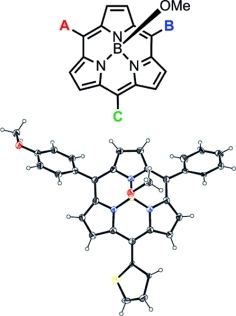
ABC-Type subporphyrins 5a–5h, which bear three different meso-aryl substituents, were rationally synthesized by condensation of AB-type tripyrranes and aroyl chlorides. ABC-Type subporphyrins 5i and 5j were synthesized by Pd-catalyzed amination reaction of 4-bromophenyl subporphyrins 5e and 5h, respectively. Comparative studies on these ABC-type subporphyrins with A3-type subporphyrins and A2B-type subporphyrins revealed that substituent effects are mostly simple superpositions of individual substituents but cooperative effects are recognized for subporphyrins which bear both electron-donating and electron-withdrawing substituents. Despite extensive attempts, enantiomeric separation of B-methoxy ABC-type subporphyrins was unsuccessful, whereas B-phenylated ABC-type subporphyrins were separated to pure enantiomers. Separated enantiomers showed weak but distinct CD signals reflecting the chiral clockwise/anticlockwise arrangements of the meso-aryl substituents. These results suggest facile racemization through SN1-type heterolysis of the B–OMe bond in solution.
@article{yoshida2014abc,title={ABC-Type meso-Triaryl-Substituted Subporphyrins},author={Yoshida, Kota and Mori, Hirotaka and Tanaka, Takayuki and Mori, Tadashi and Osuka, Atsuhiro},journal={Eur. J. Org. Chem.},volume={2014},number={19},pages={3997--4004},year={2014},publisher={Wiley Online Library},doi={10.1002/ejoc.201402435},url={https://doi.org/10.1002/ejoc.201402435},dimensions={true},tab={paper},}
Ammonia-Driven Chirality Inversion and Enhancement in Enantiodifferentiating Photocyclodimerization of 2-Anthracenecarboxylate Mediated by Diguanidino-γ-cyclodextrin
Jiabin Yao, Zhiqiang Yan, Jiecheng Ji, Wanhua Wu, Cheng Yang*, Masaki Nishijima, Gaku Fukuhara, Tadashi Mori, and Yoshihisa Inoue*
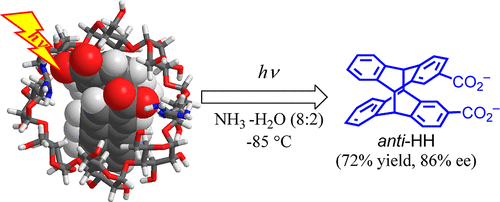
In the supramolecular photocyclodimerization of 2-anthracenecarboxylate mediated by 6A,6D-diguanidino-γ-cyclodextrin (CD), the chiral sense and enantiomeric excess of the photoproduct were dynamic functions of temperature and cosolvent to afford the (M)-anti head-to-head cyclodimer in 64 ee in aqueous methanol at −70 °C but the antipodal (P)-isomer in 86 ee in aqueous ammonia at −85 °C, while the corresponding diamino-γ-CD host did not show such unusual photochirogenic behaviors. The ee landscape was very steep against the temperature and sign-inverted against the ammonia content to reveal the opposite temperature dependence at low and high ammonia contents, for which an altered solvent structure and/or guanidinium–carboxylate interaction mode would be responsible.
@article{yao2014ammonia,title={Ammonia-Driven Chirality Inversion and Enhancement in Enantiodifferentiating Photocyclodimerization of 2-Anthracenecarboxylate Mediated by Diguanidino-γ-cyclodextrin},author={Yao, Jiabin and Yan, Zhiqiang and Ji, Jiecheng and Wu, Wanhua and Yang, Cheng and Nishijima, Masaki and Fukuhara, Gaku and Mori, Tadashi and Inoue, Yoshihisa},journal={J. Am. Chem. Soc.},volume={136},number={19},pages={6916--6919},year={2014},publisher={ACS Publications},doi={10.1021/ja5032908},url={https://doi.org/10.1021/ja5032908},dimensions={true},tab={paper},}
Sign inversion of circularly polarized luminescence by geometry manipulation of four naphthalene units introduced into a tartaric acid scaffold
Tethering four 1- versus 2-naphthyls to the same chiral scaffold derived from tartaric acid led to oppositely signed circularly polarized luminescence (CPL) and circular dichroism (CD) in solution, which not only reveals the decisive role of the spatial arrangement of chromophores/fluorophores in determining the chiroptical behaviors but also provides us with a versatile tool for switching the signs of CPL and CD without using the antipodal scaffold.
@article{amako2014sign,title={Sign inversion of circularly polarized luminescence by geometry manipulation of four naphthalene units introduced into a tartaric acid scaffold},author={Amako, Tomoyuki and Nakabayashi, Kazuki and Mori, Tadashi and Inoue, Yoshihisa and Fujiki, Michiya and Imai, Yoshitane},journal={Chem. Commun.},volume={50},number={85},pages={12836--12839},year={2014},publisher={Royal Society of Chemistry},doi={10.1039/c4cc04228j},url={https://doi.org/10.1039/c4cc04228j},dimensions={true},tab={paper},}
Mammalian serum albumins as a chiral mediator library for bio-supramolecular photochirogenesis: optimizing enantiodifferentiating photocyclodimerization of 2-anthracenecarboxylate
Masaki Nishijima*, Masato Goto, Mayu Fujikawa, Cheng Yang, Tadashi Mori, Takehiko Wada, and Yoshihisa Inoue*
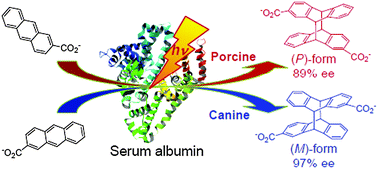
A simple strategy for choosing optimal bio-supramolecular mediators from the mammalian serum albumin library is proposed for bimolecular photochirogenic reactions. Thus, the enantiodifferentiating photocyclodimerization of 2-anthracencecarboxylate (AC) was optimized in chemical and optical yields, when mediated by porcine and canine serum albumins, both of which bound two AC molecules in the first productive site to give the (P)-enantiomer of syn-head-to-tail-cyclodimer in 69% yield and 89% enantiomeric excess (ee) for the former but the (M)-enantiomer in 77% yield and 97% ee for the latter.
@article{nishijima2014mammalian,title={Mammalian serum albumins as a chiral mediator library for bio-supramolecular photochirogenesis: optimizing enantiodifferentiating photocyclodimerization of 2-anthracenecarboxylate},author={Nishijima, Masaki and Goto, Masato and Fujikawa, Mayu and Yang, Cheng and Mori, Tadashi and Wada, Takehiko and Inoue, Yoshihisa},journal={Chem. Commun.},volume={50},number={91},pages={14082--14085},year={2014},publisher={Royal Society of Chemistry},doi={10.1039/c4cc04818k},url={https://doi.org/10.1039/c4cc04818k},dimensions={true},tab={paper},}
Supramolecular photocyclodimerization of 2-hydroxyanthracene with a chiral hydrogen-bonding template, cyclodextrin and serum albumin
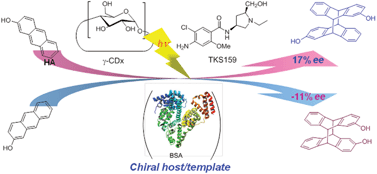
2-Hydroxyanthracene (HA) in its neutral form smoothly photocyclodimerized to four stereoisomeric [4 + 4]-cyclodimers, which were isolated and characterized for the first time, whereas the anionic form of HA turned out to be photochemically inert. Enantiodifferentiating photocyclodimerization of HA in the presence of a chiral hydrogen-bonding template (TKS159), γ-cyclodextrin (γ-CDx) and bovine serum albumin (BSA) was examined to afford chiral syn-head-to-tail and anti-head-to-head cyclodimers in modest enantiomeric excesses with TKS159 and γ-CDx, but practically no photocyclodimerization proceeded in the presence of BSA probably due to the ionization of HA in the binding sites.
@article{fukuhara2014supramolecular,title={Supramolecular photocyclodimerization of 2-hydroxyanthracene with a chiral hydrogen-bonding template, cyclodextrin and serum albumin},author={Fukuhara, Gaku and Umehara, Hiroaki and Higashino, Saki and Nishijima, Masaki and Yang, Cheng and Mori, Tadashi and Wada, Takehiko and Inoue, Yoshihisa},journal={Photochem. Photobiol. Sci.},volume={13},number={2},pages={162--171},year={2014},publisher={Springer},doi={10.1039/c3pp50127b},url={https://doi.or10.1039/c3pp50127b},dimensions={true},tab={paper},}
Manipulating γ-cyclodextrin-mediated photocyclodimerization of anthracenecarboxylate by wavelength, temperature, solvent and host
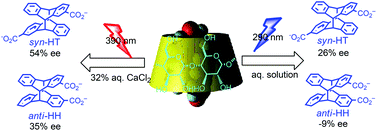
Wavelength effects on the enantiodifferentiating photocyclodimerization of 2-anthracenecarboxylate (AC) mediated by native and modified γ-cyclodextrins (CDs) were examined in different solvents at varying temperatures to manipulate the photochirogenic outcomes beyond the thermodynamically determined re/si-enantiotopic face selectivity upon 2 : 1 complexation of AC with CD in the ground state. Indeed, the stereochemical outcomes, i.e. syn/anti, head-to-tail/head-to-head (HT/HH) and in particular enantiomer ratios, were critical functions of the irradiation wavelength, irrespective of the CD host employed. Furthermore, the wavelength effects observed strongly depended on the host structure, reaction temperature and solvent employed, for which altered stacking geometry of the complexed AC pair is thought to be responsible. By optimizing the irradiation wavelength, chiral host, temperature and solvent, an enantiomeric excess of up to 54 and −37% were achieved for chiral syn-HT and anti-HH dimers.
@article{yang2014manipulating,title={Manipulating $\gamma$-cyclodextrin-mediated photocyclodimerization of anthracenecarboxylate by wavelength, temperature, solvent and host},author={Yang, Cheng and Wang, Qian and Yamauchi, Masahito and Yao, Jabing and Zhou, Dayang and Nishijima, Masaki and Fukuhara, Gaku and Mori, Tadashi and Liu, Yu and Inoue, Yoshihisa},journal={Photochem. Photobiol. Sci.},volume={13},number={2},pages={190--198},year={2014},publisher={Springer},doi={10.1039/c3pp50255d},url={https://doi.org/10.1039/c3pp50255d},dimensions={true},tab={paper},}
Combined experimental and theoretical investigation of chiroptical properties of helicenes and related molecules
@article{mori2014combined,title={Combined experimental and theoretical investigation of chiroptical properties of helicenes and related molecules},author={Mori, Tadashi},journal={Symmetry},volume={25},issue={2},pages={109--112},year={2014},publisher={Symmetry: Culture and Science}}