Supramolecular Photochirogenesis with Novel Cyclic Tetrasaccharide: Enantiodifferentiating Photoisomerization of (Z)-Cyclooctene with Cyclic Nigerosylnigerose-Based Sensitizers
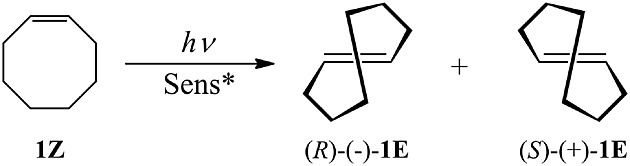
Isophthalic and terephthalic acid monoesters of cyclic nigerosyl-(1→6)-nigerose (CNN), a cyclic tetrasaccharide composed of four d-glucopyranosyl residues connected by alternating α-1,3- and α-1,6-linkages, were synthesized as novel chiral supramolecular sensitizers for enantiodifferentiating photoisomerization of (Z)-cyclooctene (1Z) to planar chiral (E)-isomer (1E). Despite the saucer-shaped shallow cavity of CNN that does not immediately guarantee strong ground-state interactions with 1Z, the sensitizer-appended CNNs afforded optically active 1E in such enantiomeric excesses that are much improved than those obtained with an α-cyclodextrin analog and comparable with those obtained with a β-cyclodextrin analog. Interestingly, the enantiomeric excess values obtained were a critical function of temperature and solvent to show an inversion of the product chirality by changing the environmental variants. Nevertheless, all of the differential activation parameters calculated from the temperature-dependent enantiomeric excesses gave an excellent compensatory enthalpy–entropy relationship, indicating an operation of a single enantiodifferentiating mechanism in the present chiral photosensitization with modified CNNs.
@article{yang2012supramolecular,title={Supramolecular Photochirogenesis with Novel Cyclic Tetrasaccharide: Enantiodifferentiating Photoisomerization of (Z)-Cyclooctene with Cyclic Nigerosylnigerose-Based Sensitizers},author={Yang, Cheng and Liang, Wenting and Nishijima, Masaki and Fukuhara, Gaku and Mori, Tadashi and Hiramatsu, Hiroyuki and Dan-oh, Yasufumi and Tsujimoto, Kazuo and Inoue, Yoshihisa},journal={Chirality},volume={24},number={11},pages={921--927},year={2012},publisher={Wiley Online Library},doi={10.1002/chir.22014},url={https://doi.org/10.1002/chir.22014},dimensions={true},tab={paper},}
Absolute configuration of atropisomeric polychlorinated biphenyl 183 enantiomerically enriched in human samples
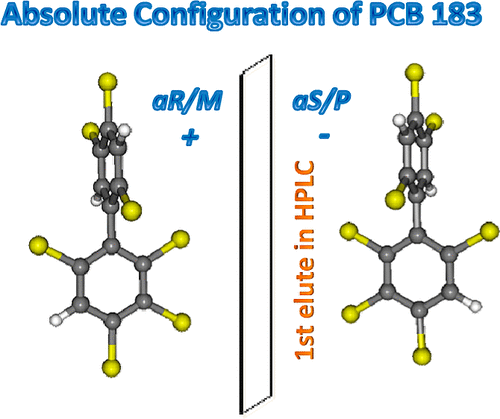
Polychlorinated biphenyls (PCBs) are still of serious concern as a potential health hazard due to their persistency and bioacumulation. Of 209 possible PCB congeners, with varying number and position of chlorine atom(s), 19 are chiral. These are mostly highly chlorinated and tend to remain longer against the biological decompositions, suffering biological deracemization in the environment. In this work, we have unequivocally determined the absolute configurations of important chiral PCBs 183 and 171, as well as 132, through the combined theoretical and experimental investigations of the chiroptical properties (circular dichroism and optical rotation), which will be valuable in elucidating the mechanism of biological enantiomer enrichment of PCBs in the environment.
@article{toda2012absolute,title={Absolute configuration of atropisomeric polychlorinated biphenyl 183 enantiomerically enriched in human samples},author={Toda, Mitsunobu and Matsumura, Chisato and Tsurukawa, Masahiro and Okuno, Toshihiro and Nakano, Takeshi and Inoue, Yoshihisa and Mori, Tadashi},journal={J. Phys. Chem. A},volume={116},number={37},pages={9340--9346},year={2012},publisher={ACS Publications},doi={10.1021/jp306363n},url={https://doi.org/10.1021/jp306363n},dimensions={true},tab={paper},}
Enantiodifferentiating photocyclodimerization of 2-anthracenecarboxylic acid via competitive binary/ternary hydrogen-bonded complexes with 4-benzamidoprolinol
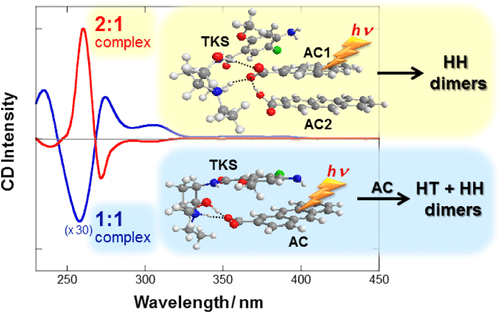
Circular dichroism (CD) spectral examinations at various host/guest ratios revealed that 2-anthracenecarboxylic acid (AC) forms not only 1:1 but also novel 2:1 hydrogen-bonded/π-stacked complexes with a chiral 4-benzamidoprolinol template (TKS159). The 2:1 complexation is a minor process but causes significant CD spectral changes as a consequence of the exciton coupling interaction of two AC chromophores and greatly accelerates the head-to-head photocyclodimerization to significantly affect the stereochemical outcomes.
@article{kawanami2012enantiodifferentiating,title={Enantiodifferentiating photocyclodimerization of 2-anthracenecarboxylic acid via competitive binary/ternary hydrogen-bonded complexes with 4-benzamidoprolinol},author={Kawanami, Yuko and Katsumata, Shin-ya and Mizoguchi, Jun-ichi and Nishijima, Masaki and Fukuhara, Gaku and Yang, Cheng and Mori, Tadashi and Inoue, Yoshihisa},journal={Org. Lett.},volume={14},number={18},pages={4962--4965},year={2012},publisher={ACS Publications},doi={10.1021/ol3023402},url={https://doi.org/10.1021/ol3023402},dimensions={true},tab={paper},}
Cyclodextrin nanosponge-sensitized enantiodifferentiating photoisomerization of cyclooctene and 1, 3-cyclooctadiene
Wenting Liang, Cheng Yang*, Masaki Nishijima, Gaku Fukuhara, Tadashi Mori, Andrea Mele*, Franca Castiglione, Fabrizio Caldera, Francesco Trotta*, and Yoshihisa Inoue*
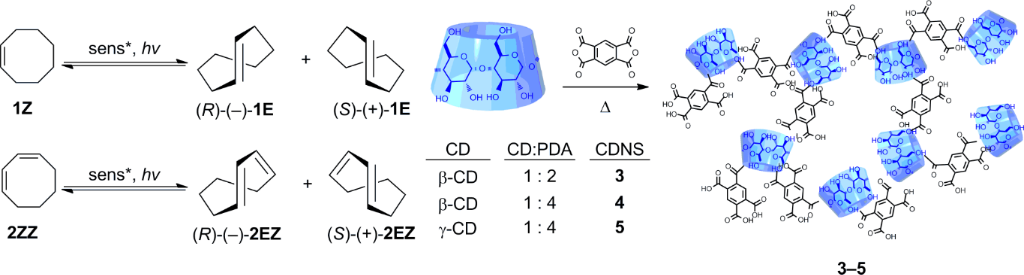
Enantiodifferentiating geometrical photoisomerizations of (Z)-cyclooctene and (Z,Z)-1,3-cyclooctadiene were performed by using the pyromellitate-linked cyclodextrin network polymer, termed “cyclodextrin nanosponge (CDNS)”, as a supramolecular sensitizing host. The photochirogenic behavior of the nanosponges incorporating β- or γ-cyclodextrin was significantly different from that reported for the conventional sensitizer-appended monomeric cyclodextrins, affording chiral (E)-cyclooctene and (E,Z)-cyclooctadiene in enantiomeric excesses critically dependent on the solution pH and solvent composition employed, revealing the active roles of chiral void spaces of CDNS in the photochirogenic reaction.
@article{liang2012cyclodextrin,title={Cyclodextrin nanosponge-sensitized enantiodifferentiating photoisomerization of cyclooctene and 1, 3-cyclooctadiene},author={Liang, Wenting and Yang, Cheng and Nishijima, Masaki and Fukuhara, Gaku and Mori, Tadashi and Mele, Andrea and Castiglione, Franca and Caldera, Fabrizio and Trotta, Francesco and Inoue, Yoshihisa},journal={Beilstein J. Org. Chem.},volume={8},number={1},pages={1305--1311},year={2012},publisher={Beilstein-Institut},doi={10.3762/bjoc.8.149},url={https://doi.org/10.3762/bjoc.8.149},dimensions={true},tab={paper},}
Theoretical and experimental studies on circular dichroism of carbo [n] helicenes
Yoshito Nakai, Tadashi Mori*, and Yoshihisa Inoue*
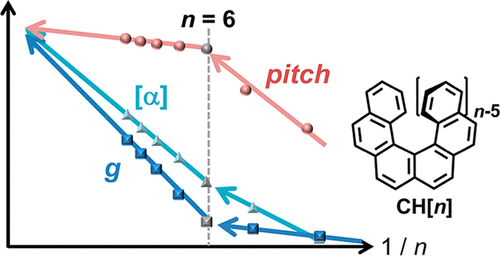
The chiroptical properties of a series of carbo[n]helicenes (n = 4–10) were investigated by the state-of-the-art approximate coupled cluster and density functional theory calculations. The theoretical calculation at the RI-CC2/TZVPP//DFT-D2-B97-D/TZVP level nicely reproduced the experimental CD spectra in both excitation energy and rotational strength without any shift or scaling. These calculations afforded the electric and the magnetic transition dipole moment vectors in [n]helicenes, allowing us to discuss the observed rotational strengths as a function of the number of benzene rings. Although the observed CD intensity was not immediately correlated to any of the calculated parameters, the anisotropy (g) factor of the 1Bb band and the specific rotation were found inversely proportional to n and nicely correlated with the helical pitch, but discontinuous at n = 6, where the aromatic rings start to overlap. In contrast, the g factor at the 1Ba band was rather insensitive to n. It was also revealed that the excitation energies of the 1Bb and 1Ba bands are inversely proportional to n over the entire range of n examined. The theoretical predictions also enabled us to rectify the erroneous experimental CD spectra of [5]- and [6]helicenes reported earlier, by using the enantiopure samples resolved by chiral HPLC.
@article{nakai2012theoretical,title={Theoretical and experimental studies on circular dichroism of carbo [n] helicenes},author={Nakai, Yoshito and Mori, Tadashi and Inoue, Yoshihisa},journal={J. Phys. Chem. A},volume={116},number={27},pages={7372--7385},year={2012},publisher={ACS Publications},doi={10.1021/jp304576g},url={https://doi.org/10.1021/jp304576g},dimensions={true},tab={paper},}
Theoretical and experimental investigations of circular dichroism and absolute configuration determination of chiral anthracene photodimers
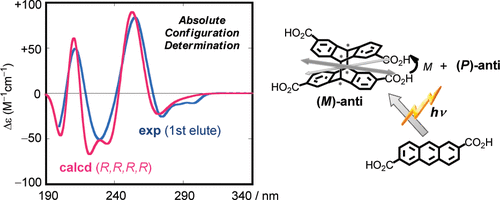
Substituted anthracenes photodimerize to stereoisomeric [4 + 4] cyclodimers, some of which are inherently chiral. Recent supramolecular photochirogenic studies enabled the efficient preparation of specific stereoisomers, the absolute configurations of which should reflect the chiral environment of supramolecular host or scaffold employed but have not been determined, hindering detailed mechanistic elucidation and further host/scaffold design. In this study, we performed the combined experimental and state-of-the-art theoretical analyses of the circular dichroism spectra of chiral cyclodimers of 2-anthracenecarboxylic and 2,6-anthracenedicarboxylic acids to reveal the configurational and molecular orbital origin of the Cotton effects observed, and unambiguously determined the absolute configurations of these chiral cyclodimers. The present results allow us to directly correlate the enantiotopic face-selectivity upon photocyclodimerization with the absolute configuration of the cyclodimer derived therefrom and also to precisely elucidate the chiral arrangement of two cyclodimerizing anthracenes.
@article{wakai2012theoretical,title={Theoretical and experimental investigations of circular dichroism and absolute configuration determination of chiral anthracene photodimers},author={Wakai, Ayako and Fukasawa, Hiroki and Yang, Cheng and Mori, Tadashi and Inoue, Yoshihisa},journal={J. Am. Chem. Soc.},volume={134},number={10},pages={4990--4997},year={2012},publisher={ACS Publications},doi={10.1021/ja300522y},url={https://doi.org/10.1021/ja300522y},dimensions={true},tab={paper},}
Control of Conformer Population and Product Selectivity and Stereoselectivity in Competitive Photocyclization/Rearrangement of Chiral Donor–Acceptor Dyad
Emi Nishiuchi, Tadashi Mori*, and Yoshihisa Inoue*
Journal of the American Chemical Society, 2012, 134, 8082–8085.
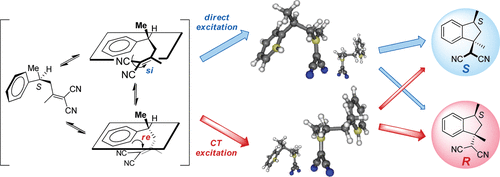
The conformer population and the relative excitation efficiency of each conformer, assessed by theoretical and experimental examinations, enabled us to precisely control the chemo- and diastereoselectivities of the competitive photocyclization/rearrangement reaction of a chiral donor–acceptor (D/A) dyad by irradiation wavelength, solvent polarity, and reaction temperature. Manipulating the ground- and excited-state conformer equilibria is essential for critically controlling the intramolecular D/A system, in sharp contrast to the rather divergent excited species involved in relevant intermolecular systems.
@article{nishiuchi2012control,title={Control of Conformer Population and Product Selectivity and Stereoselectivity in Competitive Photocyclization/Rearrangement of Chiral Donor--Acceptor Dyad},author={Nishiuchi, Emi and Mori, Tadashi and Inoue, Yoshihisa},journal={Journal of the American Chemical Society},volume={134},number={19},pages={8082--8085},year={2012},publisher={ACS Publications},doi={10.1021/ja302768w},url={https://doi.org/10.1021/ja302768w},dimensions={true},tab={paper},}
Strictly diastereocontrolled photocyclodimerization of 2-anthracenecarboxylates tethered to cyclic tetrasaccharides
Photocyclodimerization of 2-anthracenecarboxylate tethered to a cyclic nigerosylnigerose scaffold gave a single chiral cyclodimer (out of two achiral and two chiral stereoisomers) in 99% optical and 96% chemical yields, achieving the ultimate stereocontrol of the supramolecular photochirogenesis in aqueous solution at 25 °C.
@article{fukuhara2012strictly,title={Strictly diastereocontrolled photocyclodimerization of 2-anthracenecarboxylates tethered to cyclic tetrasaccharides},author={Fukuhara, Gaku and Nakamura, Tomohiro and Kawanami, Yuko and Yang, Cheng and Mori, Tadashi and Hiramatsu, Hiroyuki and Dan-Oh, Yasufumi and Tsujimoto, Kazuo and Inoue, Yoshihisa},journal={Chem. Commun.},volume={48},number={73},pages={9156--9158},year={2012},publisher={Royal Society of Chemistry},doi={10.1039/c2cc34880b},url={https://doi.org/10.1039/c2cc34880b},dimensions={true},tab={paper},}
Accomplishment of Determining Method for Absolute Configuration: Reproduction of CD Spectra by Theoretical Calculations
@article{mori2012accomplishment,title={Accomplishment of Determining Method for Absolute Configuration: Reproduction of CD Spectra by Theoretical Calculations},author={Mori, Tadashi and Inoue, Yoshihisa},journal={Kagaku},volume={67},issue={11},pages={72--73},year={2012}}