Solvent and Temperature Effects on Diastereodifferentiating Paternò- Büchi Reaction of Chiral Alkyl Cyanobenzoates with Diphenylethene upon Direct versus Charge-Transfer Excitation
Kazuyuki Matsumura, Tadashi Mori*, and Yoshihisa Inoue
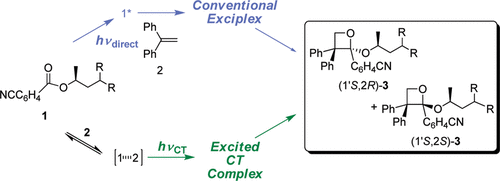
In the Paternó−Büchi reaction of chiral p-cyanobenzoates (1) with 1,1-diphenylethene (2), we revealed that the excited charge-transfer (CT) complex formed upon selective excitation at the CT band is distinctly different in structure and reactivity from the conventional exciplex generated through the direct excitation of acceptor 1 which subsequently associates with donor 2. Thus, the favored diastereoface upon photocycloaddition, as well as the temperature- and solvent-dependent behavior of the product’s diastereoselectivity, were highly contrasting, often opposite, to each other upon direct versus CT excitation. From the activation parameters obtained by the Eyring analyses of the diastereoselectivity, we are able to infer that the conventional exciplex is relatively flexible and susceptible to the environmental variants, whereas the CT complex is better π−π stacked and more rigid in the ground state and also in the excited state, leading to the significantly smaller differential activation enthalpies and entropies. More interestingly, the signs of the differential activation parameters determined for direct and CT excitation are consistently opposite to each other and the isokinetic temperatures calculated therefrom differ significantly, unambiguously revealing the distinctly different nature in structure and reactivity of these two excited-state complex species. Thus, the combined use of irradiation wavelength, temperature, and solvent provides us with a convenient, powerful tool not only for elucidating the mechanistic details of photoreaction but also for critically controlling the stereochemical outcomes of photochirogenic reaction.
@article{matsumura2010solvent,title={Solvent and Temperature Effects on Diastereodifferentiating Paternò- Büchi Reaction of Chiral Alkyl Cyanobenzoates with Diphenylethene upon Direct versus Charge-Transfer Excitation},author={Matsumura, Kazuyuki and Mori, Tadashi and Inoue, Yoshihisa},journal={J. Org. Chem.},volume={75},number={16},pages={5461--5469},year={2010},publisher={ACS Publications},doi={10.1021/jo101332x},url={https://doi.org/10.1021/jo101332x},dimensions={true},tab={paper},}
Bio-supramolecular photochirogenesis with molecular chaperone: enantiodifferentiating photocyclodimerization of 2-anthracenecarboxylate mediated by prefoldin
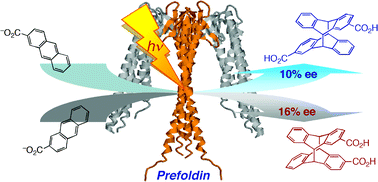
Photocyclodimerization of 2-anthracenecarboxylate mediated by molecular chaperone protein was performed for the first time to afford chiral syn-head-to-tail and anti-head-to-head dimers (2 and 3) in 10% and 16% enantiomeric excess, respectively, with enhanced yields of sterically and electrostatically less-favored head-to-head dimers (3 and 4).
@article{bando2010bio,title={Bio-supramolecular photochirogenesis with molecular chaperone: enantiodifferentiating photocyclodimerization of 2-anthracenecarboxylate mediated by prefoldin},author={Bando, Kazuki and Zako, Tamotsu and Sakono, Masafumi and Maeda, Mizuo and Wada, Takehiko and Nishijima, Masaki and Fukuhara, Gaku and Yang, Cheng and Mori, Tadashi and Pace, Tamara CS and Bohne, Cornelia and Inoue, Yoshihisa},journal={Photochem. Photobiol. Sci.},volume={9},number={5},pages={655--660},year={2010},publisher={Springer},doi={10.1039/B9PP00186G},url={https://doi.org/10.1039/B9PP00186G},dimensions={true},tab={paper},}
Diastereodifferentiating the [2+ 2] Photocycloaddition of Ethylene to Arylmenthyl Cyclohexenonecarboxylates: Stacking-Driven Enhancement of the Product Diastereoselectivity That Is Correlated with the Reactant Ellipticity
Ken Tsutsumi, Yuuki Yanagisawa, Akinori Furutani, Tsumoru Morimoto, Kiyomi Kakiuchi*, Takehiko Wada, Tadashi Mori, and Yoshihisa Inoue*
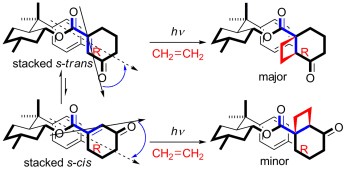
Upon diastereodifferentiating the [2+2] photocycloaddition of ethylene to a series of p-substituted (−)-8-phenylmenthyl cyclohexenonecarboxylates, the diastereoselectivity was critically controlled by the nature of the substituent introduced to the chiral auxiliary, and the p-nitro-substituted substrate afforded the cycloadducts in 90% diastereomeric excess (de) and with 97% isolated yield. Detailed experimental and theoretical conformation analyses revealed that the stacking interaction of the aromatic auxiliary with the cyclohexenone moiety plays the decisive role in determining the substrate conformation and is, therefore, responsible for the dramatic enhancement of the de. Of particular interest, the product de was directly related to the ellipticity of the substrate, enabling us to “predict” the de prior to photoirradiation.
@article{tsutsumi2010diastereodifferentiating,title={Diastereodifferentiating the [2+ 2] Photocycloaddition of Ethylene to Arylmenthyl Cyclohexenonecarboxylates: Stacking-Driven Enhancement of the Product Diastereoselectivity That Is Correlated with the Reactant Ellipticity},author={Tsutsumi, Ken and Yanagisawa, Yuuki and Furutani, Akinori and Morimoto, Tsumoru and Kakiuchi, Kiyomi and Wada, Takehiko and Mori, Tadashi and Inoue, Yoshihisa},journal={Chem. Eur. J.},volume={16},number={25},pages={7448--7455},year={2010},publisher={Wiley Online Library},doi={10.1002/chem.201000429},url={https://doi.org/10.1002/chem.201000429},dimensions={true},tab={paper},}
Critical stereocontrol by inter-amino distance of supramolecular photocyclodimerization of 2-anthracenecarboxylate mediated by 6-(ω-aminoalkylamino)-γ-cyclodextrins
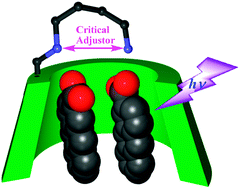
A series of 6-(ω-aminoalkylamino)-6-deoxy-γ-cyclodextrins (CDs) 5–8 with varying inter-amino distances were synthesized to control the stereoselectivity of [4+4] photocyclodimerization of 2-anthracenecarboxylate (AC). Complexation behavior of these CD hosts with AC was studied in aqueous solutions by UV-vis and circular dichroism spectral titration. Supramolecular photocyclodimerization of AC mediated by the CDs was performed in water as well as in water–methanol mixture to reveal that aminopropylamino-CD 6 leads to the formation of head-to-head photodimers 3 and 4 in highest yields, while aminobutylamino-CD 7 affords chiral syn-head-to-tail and anti-head-to-head photodimers 2 and 3 in highest enantioselectivities. These results indicate that the inter-amino distance critically control the product’s stereo- and enantioselectivities through the electrostatic interactions of two anionic AC guests with the dicationic sidechain attached to the γ-CD rim and can be used as a convenient, yet effective, tool for manipulating the stereochemical outcomes of supramolecular photochirogenesis.
@article{ke2010critical,title={Critical stereocontrol by inter-amino distance of supramolecular photocyclodimerization of 2-anthracenecarboxylate mediated by 6-(ω-aminoalkylamino)-γ-cyclodextrins},author={Ke, Chenfeng and Yang, Cheng and Liang, Wenting and Mori, Tadashi and Liu, Yu and Inoue, Yoshihisa},journal={New J. Chem.},volume={34},number={7},pages={1323--1329},year={2010},publisher={Royal Society of Chemistry},doi={10.1039/c0nj00131g},url={https://doi.org/10.1039/c0nj00131g},dimensions={true},tab={paper},}
Experimental and Theoretical Studies on the Chiroptical Properties of Donor- Acceptor Binaphthyls. Effects of Dynamic Conformer Population on Circular Dichroism
Masaki Nishizaka, Tadashi Mori*, and Yoshihisa Inoue*
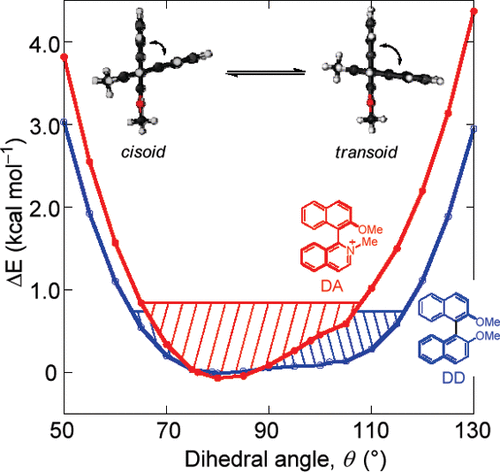
The axial chirality of biaryls has attracted much attention as effective chiral auxiliaries and ligands in asymmetric synthesis and chirality sensing. In this study, the chiroptical properties of donor−acceptor binaphthyl DA and symmetrical DD were investigated. The amplitude of the main-band couplet was enhanced in the circular dichroism (CD) spectra of DA, due to the effective cation−π interactions altering the potential energy profile against the rotational angle about the binaphthyl’s C1−C1′ bond. A shallow unsymmetrical potential curve was obtained for DA, which is in contrast to the almost symmetrical double-well potential for DD. The theoretical calculations of the CD spectra at the RI-CC2 level using the two-state model composed of the s-cis and s-trans conformations successfully reproduce the experimental CD. Dynamic conformer distribution over a wide range of dihedral angle in the chiral binaphthyls was shown to be critical in discussing the performance of such axially chiral molecules.
@article{nishizaka2010experimental,title={Experimental and Theoretical Studies on the Chiroptical Properties of Donor- Acceptor Binaphthyls. Effects of Dynamic Conformer Population on Circular Dichroism},author={Nishizaka, Masaki and Mori, Tadashi and Inoue, Yoshihisa},journal={J. Phys. Chem. Lett.},volume={1},number={12},pages={1809--1812},year={2010},publisher={ACS Publications},doi={10.1021/jz100574e},url={https://doi.org/10.1021/jz100574e},dimensions={true},tab={paper},}
Conformation Elucidation of Tethered Donor- Acceptor Binaphthyls from the Anisotropy Factor of a Charge-Transfer Band
Masaki Nishizaka, Tadashi Mori*, and Yoshihisa Inoue*
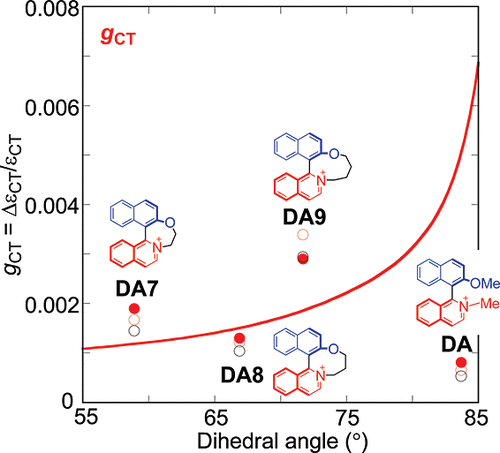
Biaryls, in particular 1,1’-binaphthyls, are widely employed as effective chiral auxiliaries and ligands in asymmetric synthesis and chirality sensing, where the amplitude and splitting energy of the main-band couplet are often used as conventional tools for elucidating the conformational details of biaryls in conjunction with relatively simple theoretical models. In this study, the chiroptical properties of a series of tethered donor−acceptor binaphthyls DAn were investigated. The theoretical calculations at the RI-CC2 level successfully reproduced the experimental spectra of all the examined DAn and revealed that the above parameters are quantitatively less informative in the conformational investigations. Alternatively, the anisotropy factor at the charge transfer (CT) band was found to be a more sensitive and robust parameter that can be exploited as a tool for analyzing the solution-phase conformation of donor−acceptor binaphthyls. A substantial contribution from the linker atoms on the anisotropy factor of the CT band was also highlighted.
@article{nishizaka2010conformation,title={Conformation Elucidation of Tethered Donor- Acceptor Binaphthyls from the Anisotropy Factor of a Charge-Transfer Band},author={Nishizaka, Masaki and Mori, Tadashi and Inoue, Yoshihisa},journal={J. Phys. Chem. Lett.},volume={1},number={15},pages={2402--2405},year={2010},publisher={ACS Publications},doi={10.1021/jz100901n},url={https://doi.org/10.1021/jz100901n},dimensions={true},tab={paper},}
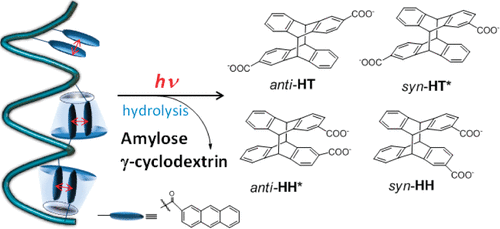
Newly synthesized 6-O-(2-anthroyl)amylose (AC-Am; 51% substitution) was photolyzed in (aqueous) DMSO solutions to give HH dimers as major products (after saponification), with modest enantiomeric excesses (ee) of 12−15% and 1−2% for syn-HT and anti-HH dimers, respectively. Addition of γ-cyclodextrin switched the product selectivity to HT and enhanced the ee of syn-HT up to 37%, while the chiral sense of anti-HH was inverted by changing the irradiation temperature, demonstrating usefulness of the dual-supramolecular approach to photochirogenesis.
@article{fukuhara2010dual,title={Dual chiral, dual supramolecular diastereodifferentiating photocyclodimerization of 2-anthracenecarboxylate tethered to amylose scaffold},author={Fukuhara, Gaku and Nakamura, Tomohiro and Yang, Cheng and Mori, Tadashi and Inoue, Yoshihisa},journal={Org. Lett.},volume={12},number={15},pages={3510--3513},year={2010},publisher={ACS Publications},doi={10.1021/ol101362s},url={https://doi.org/10.1021/ol101362s},dimensions={true},tab={paper},}
Diastereodifferentiating photocyclodimerization of 2-anthracenecarboxylate tethered to cellulose scaffold
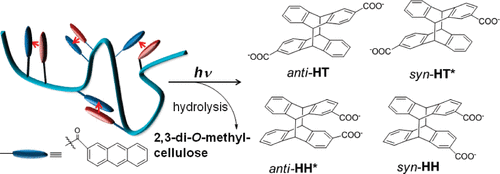
A series of anthracenecarboxylate(AC)-appended 2,3-di-O-methylcelluloses (AC-Cells) of varying degrees of substitution (DS) were synthesized to examine their photochirogenic behavior under a variety of conditions. The product distribution and enantiomeric excess of the cyclodimers obtained upon photoirradiation and the subsequent saponification were critical functions of the DS and conversion, for which a conformational change of the flexible polymer backbone is likely to be responsible.
@article{fukuhara2010diastereodifferentiating,title={Diastereodifferentiating photocyclodimerization of 2-anthracenecarboxylate tethered to cellulose scaffold},author={Fukuhara, Gaku and Nakamura, Tomohiro and Yang, Cheng and Mori, Tadashi and Inoue, Yoshihisa},journal={J. Org. Chem.},volume={75},number={12},pages={4307--4310},year={2010},publisher={ACS Publications},doi={10.1021/jo100596n},url={https://doi.org/10.1021/jo100596n},dimensions={true},tab={paper},}