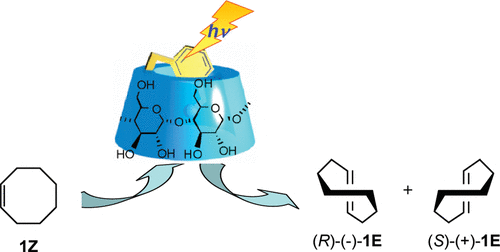
Enantiodifferentiating photoisomerization of cyclooctene included and sensitized by aroyl-β-cyclodextrins: a critical enantioselectivity control by substituents
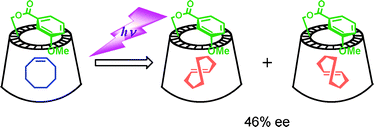
A series of 6-O-benzoyl-β-cyclodextrins (CDs) with methyl, methoxy, methoxycarbonyl, and bromo substituent(s) at the ortho-, meta-, and/or para-position(s) were synthesized as chiral sensitizing hosts for the use in supramolecular enantiodifferentiating photoisomerization of (Z)-cyclooctene (1Z) to its chiral (E)-isomer (1E). The complex stability constants (KS) of the modified β-CDs with 1Z in aqueous methanol solutions were highly sensitive to the substituent(s) introduced to the benzoate moiety, and the log KS values decreased linearly with slightly different slopes with increasing methanol content. The enantiomeric excess (ee) of 1E obtained upon photosensitization with these hosts was a critical function of the size and position of the substituent, varying from almost zero to 46% ee. This indicates that even an apparently small structural difference between methyl and methoxy can critically affect the enantiodifferentiating photoisomerization of a guest included in the chiral cavity, probably through manipulation of both the orientation of ground-state 1Z and the subsequent rotational relaxation of excited 1Z inside the chiral cavity.
@article{lu2008enantiodifferentiating,title={Enantiodifferentiating photoisomerization of cyclooctene included and sensitized by aroyl-β-cyclodextrins: a critical enantioselectivity control by substituents},author={Lu, Runhua and Yang, Cheng and Cao, Yujuan and Tong, Linhui and Jiao, Wei and Wada, Takehiko and Wang, Zhizhong and Mori, Tadashi and Inoue, Yoshihisa},journal={J. Org. Chem.},volume={73},number={19},pages={7695--7701},year={2008},publisher={ACS Publications},doi={10.1021/jo801439n},url={https://doi.org/10.1021/jo801439n},dimensions={true},tab={paper},}
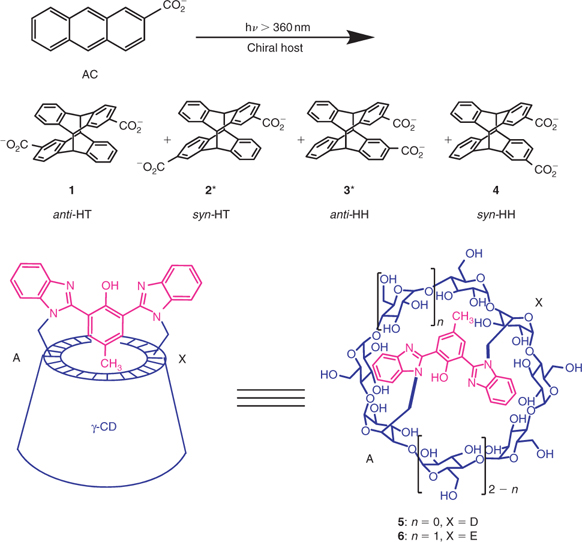
Supramolecular enantiodifferentiating photocyclodimerization of 2-anthracenecarboxylate mediated by capped γ-cyclodextrins: critical control of enantioselectivity by cap rigidity
A series of γ-cyclodextrins (CDs) modified with capping and noncapping aromatic group(s) were synthesized to mediate the enantiodifferentiating [4 + 4] photocyclodimerization of 2-anthracenecarboxylic acid (AC). The complexation behavior of these γ-CDs with AC was studied by circular dichroism, UV−vis, and NMR spectroscopy to reveal the formation of stable 1:2 host−guest complexes in all cases. The capped γ-CD with a biphenyl group bridging the A and D glucose units was shown to confine the included AC molecules most strictly among the capped and noncapped γ-CDs examined. Photocyclodimerization of AC mediated by capped γ-CDs considerably improved the yield and enantiomeric excess (ee) of the head-to-head photodimer 3. The ee and the absolute configuration of syn-head-to-tail photodimer 2 critically depended on the rigidity of capping. Thus, the flexibly capped and rim-substituted γ-CDs afforded 2 in moderate ee’s of around 40%, whereas γ-CD with a rigid biphenyl cap gave the antipodal 2 in −58% ee. Interestingly, the ee of 2 mediated by flexibly capped γ-CDs was highly sensitive to the temperature variation as a consequence of large differential entropy changes in the enantiodifferentiation process. In contrast, the entropy effect does not appear to play a significant role in the photocyclodimerization of AC with rigidly capped γ-CDs. The differential enthalpy and entropy changes obtained for the enantiodifferentiating photocyclodimerization mediated by native and most of the modified γ-CDs gave an excellent enthalpy−entropy compensation plot with an exception of the biphenyl-capped γ-CD, indicating the operation of significantly different enantiodifferentiation mechanism within the rigidly capped cyclodextrin cavity.
@article{yang2008supramolecular,title={Supramolecular enantiodifferentiating photocyclodimerization of 2-anthracenecarboxylate mediated by capped γ-cyclodextrins: critical control of enantioselectivity by cap rigidity},author={Yang, Cheng and Mori, Tadashi and Inoue, Yoshihisa},journal={J. Org. Chem.},volume={73},number={15},pages={5786--5794},year={2008},publisher={ACS Publications},doi={10.1021/jo800533y},url={https://doi.org/10.1021/jo800533y},dimensions={true},tab={paper},}
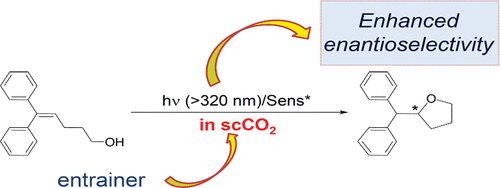
Entrainer effect on photochirogenesis in near-and supercritical carbon dioxide: Dramatic enhancement of enantioselectivity
Yasuhiro Nishiyama, Takehiko Wada, Sadayuki Asaoka, Tadashi Mori, Taylor A McCarty, Nadine D Kraut, Frank V Bright, and Yoshihisa Inoue*
Diethyl ether added as an entrainer (cosolvent) to near- and supercritical CO2 significantly enhanced the enantioselectivity of photocyclization of 5,5-diphenyl-4-penten-1-ol sensitized by saccharide naphthalenedicarboxylate to give a cyclization product in enantiomeric excesses much larger than those obtained in conventional organic solvents, revealing the unique features of nc- and sc-CO2 as well as the critical role of entrainer clustering to the intervening diastereomeric exciplex pair.
@article{nishiyama2008entrainer,title={Entrainer effect on photochirogenesis in near-and supercritical carbon dioxide: Dramatic enhancement of enantioselectivity},author={Nishiyama, Yasuhiro and Wada, Takehiko and Asaoka, Sadayuki and Mori, Tadashi and McCarty, Taylor A and Kraut, Nadine D and Bright, Frank V and Inoue, Yoshihisa},journal={J. Am. Chem. Soc.},volume={130},number={24},pages={7526--7527},year={2008},publisher={ACS Publications},doi={10.1021/ja801254z},url={https://doi.org/10.1021/ja801254z},dimensions={true},tab={paper},}
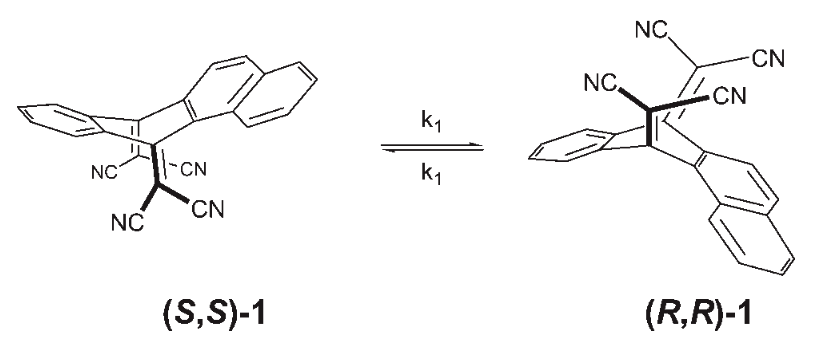
Chiroptical properties and racemization behavior of highly distorted donor-acceptor tetracyanoanthraquinodimethane with interconvertible planar chirality
Absolute configuration of optically active 7,12-bis(dicyanomethylene)-7,12-dihydrobenz[a]anthracene (1) with interconvertible planar chirality was determined by a comparison of experimental and theoretical circular dichroism (CD) spectra. Upon standing at ambient temperatures, 1 was found to spontaneously racemize, the rates of which were assessed through the separation profiles of chiral HPLC at 5–20°C and also from the CD spectral decay profiles at the same temperatures. Mechanism of the racemization was discussed.
@article{saito2008chiroptical,title={Chiroptical properties and racemization behavior of highly distorted donor-acceptor tetracyanoanthraquinodimethane with interconvertible planar chirality},author={Saito, Hideaki and Mori, Tadashi and Origane, Yumi and Wada, Takehiko and Inoue, Yoshihisa},journal={Chirality: The Pharmacological, Biological, and Chemical Consequences of Molecular Asymmetry},volume={20},number={3-4},pages={278--281},year={2008},publisher={Wiley Online Library},doi={10.1002/chir.20427},url={https://doi.org/10.1002/chir.20427},dimensions={true},tab={paper},}
pH-Controlled supramolecular enantiodifferentiating photocyclodimerization of 2-anthracenecarboxylate with capped γ-cyclodextrins
γ-Cyclodextrins capped with p-cresolbisbenzimidazole at the primary rim were synthesized and used as chiral hosts for mediating the enantiodifferentiating [4 + 4] photocyclodimerization of 2-anthracenecarboxylate. The use of 6A,6E-capped γ-cyclodextrin led to the formation of the anti-head-to-head photodimer in –5% enantiomeric excesses (ee) at pH 11 but in 28% ee at pH 6 with accompanying switching of product chirality, for which a pH-responsive conformational change of the capping moiety is likely to be responsible.
@article{yang2008ph,title={pH-Controlled supramolecular enantiodifferentiating photocyclodimerization of 2-anthracenecarboxylate with capped $\gamma$-cyclodextrins},author={Yang, Cheng and Ke, Chenfeng and Kahee, Fujita and Yuan, De-Qi and Mori, Tadashi and Inoue, Yoshihisa},journal={Aust. J. Chem.},volume={61},number={8},pages={565--568},year={2008},publisher={CSIRO Publishing},doi={10.1071/CH08143},url={https://doi.org/10.1071/CH08143},dimensions={true},tab={paper},}
Supramolecular complexation and photochirogenesis with inherently chiral molecular clip: enantiodifferentiating photoisomerization of (Z, Z)-1, 3-cyclooctadiene and polar photoaddition to 1, 1-diphenylpropene
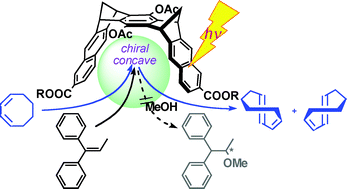
Inherently chiral molecular clip (MC) 2 binds (Z,Z)-1,3-cyclooctadiene (COD) and 1,1-diphenylpropene (DPP) in 4:1:5 THF-MeOH-H2O solution (at 25 °C) with association constants of 8800 and 27000 M−1, respectively. The thermodynamic parameters obtained from the van’t Hoff analysis (ΔH° = −96.4 kJ mol−1, ΔS° = −239 J mol−1K−1) reveal that the binding of DPP by MC is strongly driven by the enthalpic gain from hydrophobic and π–π stacking interactions, which is however largely cancelled out by the entropic loss arising from the tight molecular association. Supramolecular photosensitization by MC 2 facilitates the Z–Eisomerization of COD to chiral (E,Z)-isomer in a good E/Z ratio of 0.19 and a low ee of 0.7%, but does not appear to work with DPP probably due to the less-efficient electron transfer in the acceptor–donor–acceptor complex of DPP with MC 2.
@article{fukuhara2008supramolecular,title={Supramolecular complexation and photochirogenesis with inherently chiral molecular clip: enantiodifferentiating photoisomerization of (Z, Z)-1, 3-cyclooctadiene and polar photoaddition to 1, 1-diphenylpropene},author={Fukuhara, Gaku and Klärner, Frank-Gerrit and Mori, Tadashi and Wada, Takehiko and Inoue, Yoshihisa},journal={Photochem. Photobiol. Sci.},volume={7},number={12},pages={1493--1500},year={2008},publisher={Springer},doi={10.1039/b812186a},url={https://doi.org/10.1039/b812186a},dimensions={true},tab={paper},}
Supramolecular enantiodifferentiating photoisomerization of cyclooctene with modified β-cyclodextrins: critical control by a host structure
Enantiodifferentiating photoisomerization of (Z)-cyclooctene included and sensitized by m-methoxybenzoyl-β-cyclodextrin gave chiral (E)-isomers in up to 46% enantiomeric excess, which is the highest value ever reported for supramolecular photochirogenesis with analogous hosts, thus demonstrating the crucial role of the sensitizer-spacer moiety in supramolecular photochirogenic systems.
@article{lu2008supramolecular,title={Supramolecular enantiodifferentiating photoisomerization of cyclooctene with modified $\beta$-cyclodextrins: critical control by a host structure},author={Lu, Runhua and Yang, Cheng and Cao, Yujuan and Wang, Zhizhong and Wada, Takehiko and Jiao, Wei and Mori, Tadashi and Inoue, Yoshihisa},journal={Chem. Commun.},volume={3},pages={374--376},year={2008},publisher={Royal Society of Chemistry},doi={10.1039/b714300a},url={https://doi.org/10.1039/b714300a},dimensions={true},tab={paper},}
Highly stereoselective photocyclodimerization of α-cyclodextrin-appended anthracene mediated by γ-cyclodextrin and cucurbit [8] uril: a dramatic steric effect operating outside the binding site
Cheng Yang, Tadashi Mori, Yumi Origane, Young Ho Ko, Narayanan Selvapalam, Kimoon Kim, and Yoshihisa Inoue*
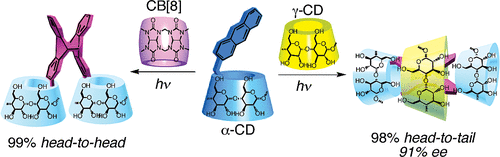
Photocyclodimerization of α-cyclodextrin (CD)-appended anthracene was studied in the presence of γ-CD and cucurbit[8]uril (CB[8]) hosts to manipulate the stereodifferentiating photoreaction occurring inside the cavity by the bulky attachment located outside. The γ-CD-mediated photodimerization afforded the head-to-tail photodimers in 98% combined yield, in particular, the syn-head-to-tail photodimer of 91% ee in 68% yield, which are much greater than 32% ee and 44% yield obtained with unmodified anthracene carboxylate. The use of CB[8] also led to a striking inversion of the head-to-tail/head-to-head selectivity, affording exclusively the head-to-head photodimers in 99% combined yield.
@article{yang2008highly,title={Highly stereoselective photocyclodimerization of α-cyclodextrin-appended anthracene mediated by γ-cyclodextrin and cucurbit [8] uril: a dramatic steric effect operating outside the binding site},author={Yang, Cheng and Mori, Tadashi and Origane, Yumi and Ko, Young Ho and Selvapalam, Narayanan and Kim, Kimoon and Inoue, Yoshihisa},journal={J. Am. Chem. Soc.},volume={130},number={27},pages={8574--8575},year={2008},publisher={ACS Publications},doi={10.1021/ja8032923},url={https://doi.org/10.1021/ja8032923},dimensions={true},tab={paper},}
Synthesis of functionalized β-cyclodextrins by “click chemistry”
Two new β-cyclodextrins (β-CDs) modified with chromophore were synthesized in high yields through Huisgen 1,3-dipolar cycloaddition. The amount of Cu catalyst was demonstrated to be a key factor that determines the yield of the 1,3-dipolar cycloaddition when applied to CD derivatization. While a catalytic amount of Cu-catalyst is commonly required in conventional click chemistry, more than a half equivalent of Cu catalyst was desirable for obtaining the modified CDs in satisfactory yields.
@article{ke2008synthesis,title={Synthesis of functionalized β-cyclodextrins by “click chemistry”},author={Ke, Chenfeng and Yang, Cheng and Yang, Zixin and Wu, Weijia and Mori, Tadashi and Inoue, Yoshihisa and Liu, Yu},journal={Heterocycles},volume={76},number={1},pages={155--160},year={2008},publisher={Japan Institute of Heterocyclic Chemistry},doi={10.3987/COM-08-S(N)16},url={https://doi.org/10.3987/COM-08-S(N)16},dimensions={true},tab={paper},}
Novel cation-π interaction revealed by crystal structure of thermoalkalophilic lipase
Hiroyoshi Matsumura*, Takahiko Yamamoto, Thean Chor Leow, Tadashi Mori, Abu Bakar Salleh, Mahiran Basri, Tsuyoshi Inoue, Yasushi Kai, and Raja Noor Zaliha Raja Abd Rahman*
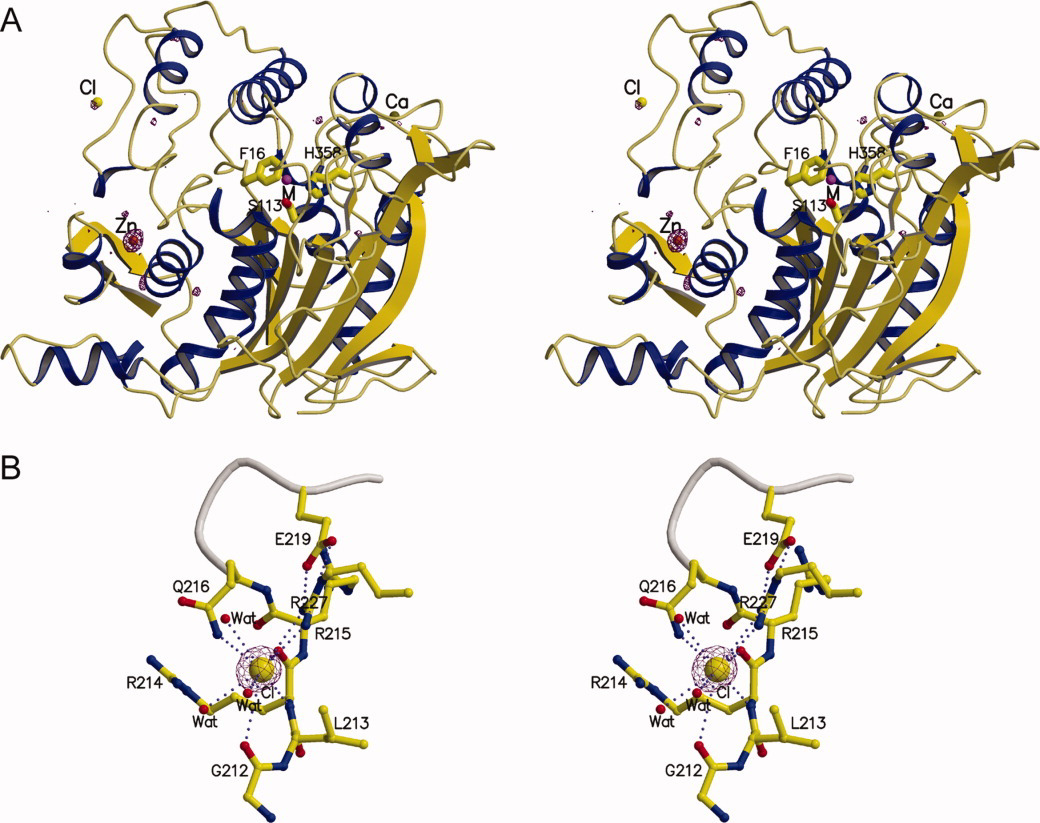
Cation-π interactions are unique binding motifs that frequently occur between electron-rich aromatic ring and organic and inorganic (metallic) cations. This noncovalent interaction can be strong, as has been confirmed by the solid state studies of small molecule crystal structures,1, 2 and the theoretical and experimental analyses in aqueous media.3 A previous protein database search showed that the cation-π interaction can occur for every 77 amino acid residues in proteins, where the positively charged amino acids (e.g., arginine and lysine) and the aromatic amino acids (e.g., tryptophan, tyrosine, phenylananine) are usually involved.4 Cation-π interactions are therefore considered to be an essential force in generating the tertiary and quaternary structures of proteins that are induced by oligomerization and protein folding. These interactions are also important in biological processes such as protein–ligand1, 5, 6 and protein–DNA7-9 complex formations.
@article{matsumura2008novel,title={Novel cation-π interaction revealed by crystal structure of thermoalkalophilic lipase},author={Matsumura, Hiroyoshi and Yamamoto, Takahiko and Leow, Thean Chor and Mori, Tadashi and Salleh, Abu Bakar and Basri, Mahiran and Inoue, Tsuyoshi and Kai, Yasushi and Rahman, Raja Noor Zaliha Raja Abd},journal={Proteins},volume={70},number={2},pages={592--598},year={2008},publisher={Wiley Online Library},doi={10.1002/prot.21799},url={https://doi.org/10.1002/prot.21799},dimensions={true},tab={paper},}