Time dependent density functional theory calculations for electronic circular dichroism spectra and optical rotations of conformationally flexible chiral donor- acceptor dyad
Tadashi Mori*, Yoshihisa Inoue, and Stefan Grimme*
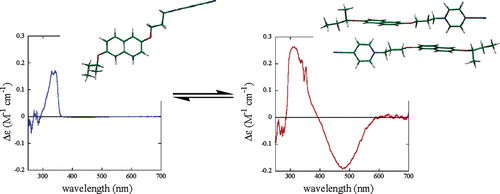
Twelve conformations of a chiral donor−acceptor (charge-transfer) dyad and six conformations of its dimer complex were structurally optimized by using the Kohn−Sham density functional theory (BLYP/TZV2P) incorporating a recently developed empirical correction scheme that uses C6/R6 potentials for van der Waals interactions (DFT-D). Subsequent time-dependent DFT calculations with BH-LYP and B3-LYP functionals (with triple-ζ basis set) were performed to obtain theoretical circular dichroism (CD) spectra. The experimental CD spectra obtained independently were properly reproduced by averaging the calculated spectra of individual conformers according to a Boltzmann population derived from single-point SCS-MP2 energies. The optical rotations of the monomer were also calculated by using the same functionals with an aug-cc-pVDZ basis set. Dielectric continuum solvation models (COSMO) applied to correct the relative energies from the isolated molecule calculations resulted in conformer distributions that piled the same or even poorer level of agreement with the experimental CD spectrum. Our results clearly show the advantage of the DFT-D method for the geometry optimization of large systems with donor−acceptor interactions and the TD-DFT/BH-LYP calculations for reproducing the experimental CD spectra. As compared with the calculated optical rotations, the wealthy information embedded in the experimental/calculated CD spectra is requisite for the configurational and/or conformational analyses of relatively large and flexible chiral organic molecules in solution.
@article{mori2006time,title={Time dependent density functional theory calculations for electronic circular dichroism spectra and optical rotations of conformationally flexible chiral donor- acceptor dyad},author={Mori, Tadashi and Inoue, Yoshihisa and Grimme, Stefan},journal={J. Org. Chem.},volume={71},number={26},pages={9797--9806},year={2006},publisher={ACS Publications},doi={10.1021/jo061855i},url={https://doi.org/10.1021/jo061855i},dimensions={true},tab={paper},}
Circular dichroism of intra-and intermolecular charge-transfer complexes. Enhancement of anisotropy factors by dimer formation and by confinement
Tadashi Mori*, Young Ho Ko, Kimoon Kim, and Yoshihisa Inoue*
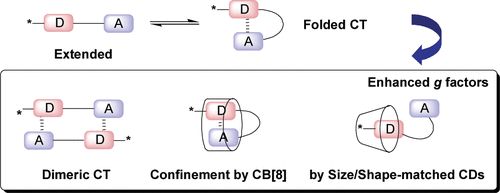
The dynamic behavior of new CT-dyads has been studied by means of UV−vis, fluorescence, and NMR spectroscopies under a variety of conditions. It was found that the CT-dyads exhibit conformational variations, such as extended and folded monomers and an antiparallel dimer complex, depending on the conditions. The CT interaction was found in the folded conformation at ambient temperature, while the contribution of the dimeric species became evident at lower temperatures. Most interestingly, close examinations of the circular dichroism spectra of these CT-dyads reveal that the anisotropy (g) factors of the dimers are significantly enhanced by a factor of ∼30 in the CT transition region. Such enhancement is rationalized in terms of the stronger CT interactions in the dimer through the double electronic coupling element, which imposes stronger restrictions on the rotation of alkyl group(s). Confinement of the CT-dyads in cyclodextrin (CD) and cucurbituril cavities afforded further insights into the chiroptical properties of the CT-dyad. The effects of confinement are clearly size-dependent, exhibiting a substantial enhancement of the g factors by a factor of 5−10 upon inclusion by β-CD and also by cucurbit[8]uril, but with no appreciable changes upon complexation with the other CDs. These results indicate that the conformational fixation of CT-dyads, for example by dimer formation or by confinement in size/shape-matched cavities, is a conventional, yet powerful, tool for manipulating (mostly enhancing) the chiroptical properties of the CT transition, which should be applicable in general to a variety of molecular and supramolecular CT systems.
@article{mori2006circular,title={Circular dichroism of intra-and intermolecular charge-transfer complexes. Enhancement of anisotropy factors by dimer formation and by confinement},author={Mori, Tadashi and Ko, Young Ho and Kim, Kimoon and Inoue, Yoshihisa},journal={J. Org. Chem.},volume={71},number={8},pages={3232--3247},year={2006},publisher={ACS Publications},doi={10.1021/jo0602672},url={https://doi.org/10.1021/jo0602672},dimensions={true},tab={paper},}
Switching of product’s chirality in diastereodifferentiating [2+ 2] photocycloaddition of (E)-versus (Z)-stilbene to chiral fumarate upon direct and charge-transfer-band excitation
Hideaki Saito, Tadashi Mori*, Takehiko Wada, and Yoshihisa Inoue*
Diastereodifferentiating [2+2] photocycloadditions of (E)- and (Z)-stilbenes to bis((R)-1-methylpropyl) fumarate were performed through the direct excitation of stilbenes and the selective excitation of the charge-transfer (CT) complex at various temperatures. The geometrical isomers of stilbene afforded the opposite diastereomers of μ-truxinate in both excitation modes, with a dramatic decrease in the product’s diastereoselectivity upon prolonged irradiations.
@article{saito2006switching,title={Switching of product's chirality in diastereodifferentiating [2+ 2] photocycloaddition of (E)-versus (Z)-stilbene to chiral fumarate upon direct and charge-transfer-band excitation},author={Saito, Hideaki and Mori, Tadashi and Wada, Takehiko and Inoue, Yoshihisa},journal={Org. Lett.},volume={8},number={9},pages={1909--1912},year={2006},publisher={ACS Publications},doi={10.1021/ol060468s},url={https://doi.org/10.1021/ol060468s},dimensions={true},tab={paper},}
Entropy-Controlled Supramolecular Photochirogenesis: Enantiodifferentiating Z- E Photoisomerization of Cyclooctene Included and Sensitized by Permethylated 6-O-Modified β-Cyclodextrins
Gaku Fukuhara, Tadashi Mori, Takehiko Wada, and Yoshihisa Inoue*
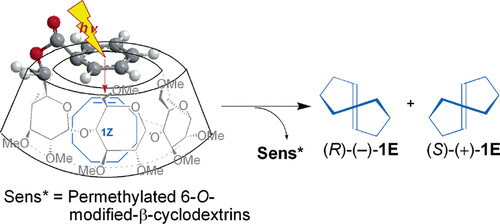
Permethylated 6-O-modified β-cyclodextrins 2a−2d were synthesized as novel photosensitizing hosts with a flexible skeleton. Circular dichroism (CD) and 2D NMR spectral examinations of benzoate 2a revealed that the benzoate moiety is deeply included into its own cavity in aqueous solution. Upon addition of (Z)-cyclooctene (1Z) to a 50% aqueous methanol solution of 2a at 25 °C, the benzoate moiety of 2a was gradually excluded from the cavity as indicated by the CD spectral changes; the Job’s plot revealed the formation of a 1:1 complex of 2a with 1Z. The binding constants for the complexation of 1Z by 2a were determined by CD spectral titration in 50% aqueous methanol at various temperatures. The van’t Hoff analysis of the obtained data afforded the thermodynamic parameters (ΔH° = −3.1 kJ mol-1, ΔS° = 48.5 J mol-1 K-1), demonstrating the entropy-driven complexation by the permethylated cyclodextrin. This is in sharp contrast to the complexation of 1Z by nonmethylated β-cyclodextrin benzoate that is driven by enthalpy (ΔH° = −31.8 kJ mol-1 and ΔS° = −51.1 J mol-1 K-1). Upon supramolecular photosensitization with 2a−2d, 1Z isomerized to the (E)-isomer (1E) in moderate enantiomeric excesses (ee’s), which however displayed significant temperature dependence with accompanying switching of the product’s chirality in an extreme case. Such dynamic behavior of ee is very different from that reported for the photosensitization with nonmethylated cyclodextrin benzoate, where the product’s ee is controlled by host occupancy. Eyring treatment of the ee obtained at various temperatures (<0 °C) gave the differential activation parameters for the enantiodifferentiation process occurring in the supramolecular exciplex, revealing the crucial role of entropy, as indicated by the ΔΔS⧧ value changing dynamically from +4 to −24 J K-1 mol-1. The origin of the contrasting behavior of permethylated versus nonmethylated cyclodextrin hosts is inferred to be the conformational flexibility of the former host, which enables the entropy-driven guest complexation in the ground state and the entropy-controlled enantiodifferentiation in the excited state.
@article{fukuhara2006entropy,title={Entropy-Controlled Supramolecular Photochirogenesis: Enantiodifferentiating Z- E Photoisomerization of Cyclooctene Included and Sensitized by Permethylated 6-O-Modified β-Cyclodextrins},author={Fukuhara, Gaku and Mori, Tadashi and Wada, Takehiko and Inoue, Yoshihisa},journal={J. Org. Chem.},volume={71},number={21},pages={8233--8243},year={2006},publisher={ACS Publications},doi={10.1021/jo061389x},url={https://doi.org/10.1021/jo061389x},dimensions={true},tab={paper},}
The first supramolecular photosensitization of enantiodifferentiating bimolecular reaction: anti-Markovnikov photoaddition of methanol to 1, 1-diphenylpropene sensitized by modified β-cyclodextrin
Gaku Fukuhara, Tadashi Mori, Takehiko Wada, and Yoshihisa Inoue*
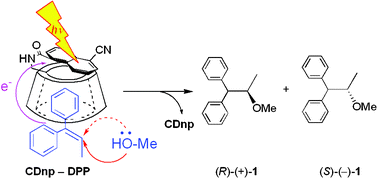
Enantiodifferentiating polar photoaddition of methanol to 1,1-diphenylpropene included and sensitized by cyanonaphthalene-modified β-cyclodextrin was examined for the first time to give optically active anti-Markovnikov adduct with accompanying inversion of the chiral sense of the photoproduct by temperature, which is entropic in origin.
@article{fukuhara2006first,title={The first supramolecular photosensitization of enantiodifferentiating bimolecular reaction: anti-Markovnikov photoaddition of methanol to 1, 1-diphenylpropene sensitized by modified β-cyclodextrin},author={Fukuhara, Gaku and Mori, Tadashi and Wada, Takehiko and Inoue, Yoshihisa},journal={Chem. Commun.},number={16},pages={1712--1714},year={2006},publisher={Royal Society of Chemistry},doi={10.1039/b601674j},url={https://doi.org/10.1039/b601674j},dimensions={true},tab={paper},}