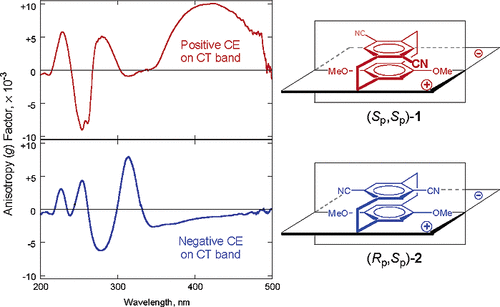
Absolute Configuration of Chiral [2.2]Paracyclophanes with Intramolecular Charge-Transfer Interaction. Failure of the Exciton Chirality Method and Use of the Sector Rule Applied to the Cotton Effect of the CT Transition
Takahiro Furo, Tadashi Mori*, Takehiko Wada, and Yoshihisa Inoue*
Optically active 4,7-dicyano-12,15-dimethoxy[2.2]paracyclophanes have been separated by chiral HPLC and their absolute configurations determined by comparison of the experimental and the theoretical VCD spectra. X-ray crystallographic structures for both diastereomers are also reported. The electronic circular dichroism spectra of these enantiomeric pairs, as chiral intramolecular charge-transfer complexes, have been obtained for the first time. The exciton coupling method, usually used for determining the absolute configuration of chiral molecules, however, did not give a correct prediction for the present CT−paracyclophane system. Instead, empirical sector rules for the signs of the Cotton effects of the CT transition can be applied for the assignment of the absolute configuration.
@article{furo2005absolute,title={Absolute Configuration of Chiral [2.2]Paracyclophanes with Intramolecular Charge-Transfer Interaction. Failure of the Exciton Chirality Method and Use of the Sector Rule Applied to the Cotton Effect of the CT Transition},author={Furo, Takahiro and Mori, Tadashi and Wada, Takehiko and Inoue, Yoshihisa},journal={J. Am. Chem. Soc.},volume={127},number={23},pages={8242--8243},year={2005},publisher={ACS Publications},doi={10.1021/ja0508323},url={https://doi.org/10.1021/ja0508323},dimensions={true},tab={paper},}
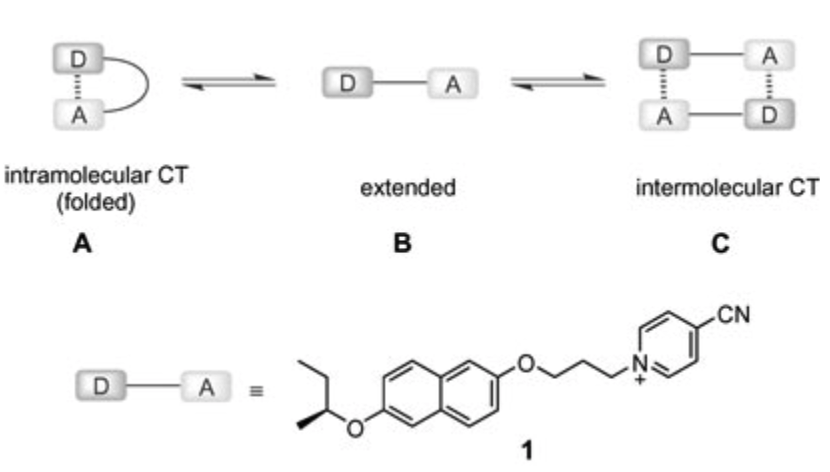
Circular Dichroism of a Chiral Tethered Donor-Acceptor System: Enhanced Anisotropy Factors in Charge-Transfer Transitions by Dimer Formation and by Confinement
A charge-transfer (CT) dyad with a trimethylene tether forms a folded or extended monomer or a dimer depending on the conditions (see picture). Both dimer formation at low temperatures and monomer confinement by inclusion in a cyclodextrin cavity greatly enhance the anisotropy factor of the CT transition of the complex.
@article{mori2005circular,title={Circular Dichroism of a Chiral Tethered Donor-Acceptor System: Enhanced Anisotropy Factors in Charge-Transfer Transitions by Dimer Formation and by Confinement},author={Mori, Tadashi and Inoue, Yoshihisa},journal={Angew. Chem. Int. Ed.},volume={44},number={17},pages={2582--2585},year={2005},publisher={Weily},doi={10.1002/anie.200462071},url={https://doi.org/10.1002/anie.200462071},dimensions={true},tab={paper},}
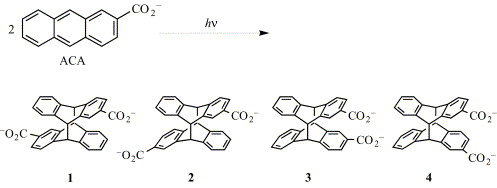
Enantiodifferentiating [4+ 4] photocyclodimerization of 2-anthracenecarboxylate catalyzed by 6A, 6X-diamino-6A, 6X-dideoxy-h-cyclodextrins: Manipulation of product chirality by electrostatic interaction, temperature and solvent in supramolecular photochirogenesis
6A,6X-Dideoxy-6A,6X-diamino-γ-cyclodextrins (X = B, C, D and E) 5a–d were synthesized as chiral hosts for catalyzing the enantiodifferentiating [4 + 4] photocyclodimerization of 2-anthracenecarboxylic acid (ACA). The electrostatic interaction between 5a–d and ACA efficiently affected the preorganization of two ACA molecules within the γ-CD cavity, and improved the yields of head-to-head cyclodimers. By lowering the reaction temperature or solvent polarity, the electrostatic interaction was further enhanced. The anti-to-syn ratio of the head-to-head isomers gradually increased by changing the host from 5a to 5d (with increasing distance between the two amino groups on the CD rim), demonstrating a good structure–function relationship in this supramolecular photoreaction system. The chiral sense and enantiomeric excess of the photoproducts obtained are significantly affected, and even inverted, by solvent composition and reaction temperature. This temperature- and solvent-controlled chirality switching behavior is proven to originate from the contribution of non-zero differential entropy (ΔΔS‡) in the enantiodifferentiating process. This finding is the first example of a chirality inversion driven by entropy-related factors, such as solvent and temperature, in a non-sensitized asymmetric photoreaction. The sign of ΔΔS‡ was switched by the composition of solvent and exhibited an excellent compensatory relationship against the differential enthalpy (ΔΔH‡), revealing that the photoenantiodifferentiation is governed not only by enthalpy but also by entropy, and also that the enantiodifferentiation mechanism does not vary throughout the whole system, irrespective of the condition changes.
@article{yang2005enantiodifferentiating,title={Enantiodifferentiating [4+ 4] photocyclodimerization of 2-anthracenecarboxylate catalyzed by 6A, 6X-diamino-6A, 6X-dideoxy-h-cyclodextrins: Manipulation of product chirality by electrostatic interaction, temperature and solvent in supramolecular photochirogenesis},author={Yang, Cheng and Fukuhara, Gaku and Nakamura, Asao and Origane, Yumi and Fujita, Kahee and Yuan, De-Qi and Mori, Tadashi and Wada, Takehiko and Inoue, Yoshihisa},journal={J. Photochem. Photobiol. A: Chem.},volume={173},number={3},pages={375--383},year={2005},publisher={Elsevier},doi={10.1016/j.jphotochem.2005.04.017},url={https://doi.org/10.1016/j.jphotochem.2005.04.017},dimensions={true},tab={paper},}
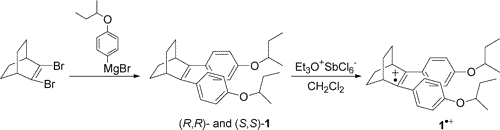
Chiral organic radical cation and dication. A reversible chiroptical redox switch based on stepwise transformation of optically active tetrakis (p-alkoxyphenyl) ethylenes to radical cations and dications
Optically active tetrakis(p-alkoxyphenyl)ethylenes were found to function as reversible chiroptical switches upon redox transformations. Successive one-electron oxidations of chirally modified tetraarylethylene to the corresponding radical cation and then to the dication led to dramatic changes in the electronic absorption and circular dichroism (CD) spectra. The neutral species showed no color or CD in the visible region, while the radical ion was blue in color and exhibited a weak Cotton effect, with the dication green and giving an intense Cotton effect and a sign opposite that observed for the radical cation, at a longer wavelength. Molecular orbital calculations and X-ray crystallographic studies clearly indicate that the olefinic CC bond is significantly twisted in the dication to minimize the electrostatic and steric repulsions. By lowering the temperature of the dication, the twist around the double bond is more firmly fixed in either P or M chirality to give a stronger Cotton effect and a larger anisotropy (g) factor. Since the spectral changes are completely reversible and reproducible for multiple redox cycles, this chiral redox system can be used in novel redox-driven chiroptical applications, such as molecular switches and memory devices, in which the information is written/read chiroptically in the ternary mode, giving zero CD signal in the neutral form, positive CD for the radical cation, and negative CD for the dication at a given wavelength.
@article{mori2005chiral,title={Chiral organic radical cation and dication. A reversible chiroptical redox switch based on stepwise transformation of optically active tetrakis (p-alkoxyphenyl) ethylenes to radical cations and dications},author={Mori, Tadashi and Inoue, Yoshihisa},journal={J. Phys. Chem. A},volume={109},number={12},pages={2728--2740},year={2005},publisher={ACS Publications},doi={10.1021/jp044917m},url={https://doi.org/10.1021/jp044917m},dimensions={true},tab={paper},}
Entropy-controlled supramolecular photochirogenesis: enantiodifferentiating Z–E photoisomerization of cyclooctene included and sensitized by permethylated 6-O-benzoyl-β-cyclodextrin
Gaku Fukuhara, Tadashi Mori, Takehiko Wada, and Yoshihisa Inoue
In contrast to the photosensitization with a non-methylated analogue, supramolecular photochirogenesis with a novel permethylated mono(6-O-benzoyl)-β-cyclodextrin exhibited a critical dependence of the product’s enantiomeric excess upon temperature, and possessed a large differential entropy of activation (−11 J K−1 mol−1) for which the flexible host skeleton is likely to be responsible.
@article{fukuhara2005entropy,title={Entropy-controlled supramolecular photochirogenesis: enantiodifferentiating Z--E photoisomerization of cyclooctene included and sensitized by permethylated 6-O-benzoyl-β-cyclodextrin},author={Fukuhara, Gaku and Mori, Tadashi and Wada, Takehiko and Inoue, Yoshihisa},journal={Chem. Commun.},number={33},pages={4199--4201},year={2005},publisher={Royal Society of Chemistry},doi={10.1039/b504948b},url={https://doi.org/10.1039/b504948b},dimensions={true},tab={paper},}
New Paradigm of Electrophilic Substitution Mechanism
@article{mori2005new,title={New Paradigm of Electrophilic Substitution Mechanism},author={Mori, Tadashi and Inoue, Yoshihisa},journal={Kagaku},volume={60},issue={4},pages={76--77},year={2005}}
 Enantiodifferentiating [4+ 4] photocyclodimerization of 2-anthracenecarboxylate catalyzed by 6A, 6X-diamino-6A, 6X-dideoxy-h-cyclodextrins: Manipulation of product chirality by electrostatic interaction, temperature and solvent in supramolecular photochirogenesisJ. Photochem. Photobiol. A: Chem., 2005, 173, 375–383.