The geometry (donor–acceptor distance) and association constant of the ground-state CT complex were considerably affected by applied pressure, thus enhancing the reaction rate and the adduct yield particularly upon CT excitation, but the diastereoselectivity did not show any substantial change at elevated pressures in both excitation modes.
@article{saito2004pressure,title={Pressure control of diastereodifferentiating [2+ 2] photocycloaddition of (E)-stilbene to chiral fumarate upon direct and charge-transfer excitation},author={Saito, Hideaki and Mori, Tadashi and Wada, Takehiko and Inoue, Yoshihisa},journal={Chem. Commun.},number={14},pages={1652--1653},year={2004},publisher={Royal Society of Chemistry},doi={10.1039/b404555f},url={https://doi.org/10.1039/b404555f},dimensions={true},tab={paper},}
Diastereoselective [2+ 2] photocycloaddition of stilbene to chiral fumarate. Direct versus charge-transfer excitation
Hideaki Saito, Tadashi Mori*, Takehiko Wada, and Yoshihisa Inoue*
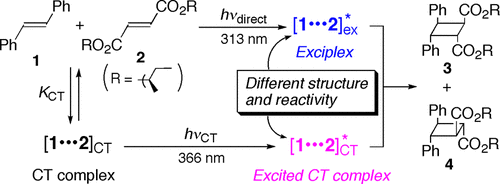
The selective excitation of the charge-transfer (CT) complex and the direct excitation of the substrate gave distinctly different product ratios and diastereomeric excesses (de’s), as well as their temperature dependencies, in [2 + 2] photocycloaddition of (E)-stilbene to bis((R)-1-methylpropyl) fumarate, clearly demonstrating that the excited CT complex and the conventional exciplex differ in structure and reactivity. This conclusion is supported by the contrasting fluorescence behavior exhibited by the relevant excited species, particularly at low temperatures.
@article{saito2004diastereoselective,title={Diastereoselective [2+ 2] photocycloaddition of stilbene to chiral fumarate. Direct versus charge-transfer excitation},author={Saito, Hideaki and Mori, Tadashi and Wada, Takehiko and Inoue, Yoshihisa},journal={J. Am. Chem. Soc.},volume={126},number={6},pages={1900--1906},year={2004},publisher={ACS Publications},doi={10.1021/ja0370140},url={https://doi.org/10.1021/ja0370140},dimensions={true},tab={paper},}
Enantiodifferentiating photoaddition of alcohols to 1, 1-diphenylpropene in supercritical carbon dioxide: Sudden jump of optical yield at the critical density
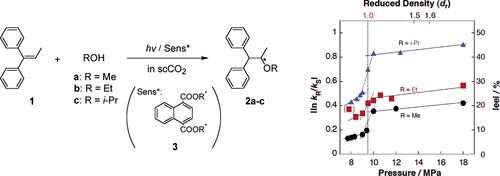
In the enantiodifferentiating photoaddition of ROH (R = Me, Et, i-Pr) to 1,1-diphenylpropene sensitized by fructosyl 1,4-naphthalenedicarboxylate in supercritical carbon dioxide, the enantiomeric excess of photoadduct increased with increasing bulkiness of the alcohol at all pressures used, with an accompanying sudden jump at the critical density, for which the enhanced clustering of alcohol, particularly in the subcritical pressure region, was revealed to be responsible from the fluorescence spectral examinations.
@article{nishiyama2004enantiodifferentiating,title={Enantiodifferentiating photoaddition of alcohols to 1, 1-diphenylpropene in supercritical carbon dioxide: Sudden jump of optical yield at the critical density},author={Nishiyama, Yasuhiro and Kaneda, Masayuki and Saito, Ryota and Mori, Tadashi and Wada, Takehiko and Inoue, Yoshihisa},journal={J. Am. Chem. Soc.},volume={126},number={21},pages={6568--6569},year={2004},publisher={ACS Publications},doi={10.1021/ja0494609},url={https://doi.org/10.1021/ja0494609},dimensions={true},tab={paper},}
Mediation of conformationally controlled photodecarboxylations of chiral and cyclic aryl esters by substrate structure, temperature, pressure, and medium constraints
Tadashi Mori*, Richard G Weiss, and Yoshihisa Inoue*
An aryl alkanoate, 2,4,6-trimethylphenyl (S)-(+)-2-methylbutyrate, whose ester group has a chiral center alpha to the carbonyl carbon and in which photo-Fries rearrangements are blocked by methyl substituents, undergoes facile photodecarboxylation under a variety of conditions and with complete retention of configuration. In fact, the decarboxylation process has many of the attributes of a symmetry-allowed suprafacial [1,3]sigmatropic rearrangement. The process requires concerted extrusion of carbon dioxide in a spiro-lactonic transition state, which has been investigated using high level DFT and CIS calculations: thermally less stable s-cis conformers in the ground and excited singlet states play an important role in determining the competitive efficiency of the process. Conformational control has also been imposed by substrate structure, solvent interactions, temperature, and applying external pressure, as well as using constraining media such as cyclodextrins and polyethylene films. The results are correlated with steady-state and dynamic fluorescence measurements at various temperatures in order to investigate further degrees to which ground and excited singlet state conformations affect the different photoreactivity channels available to the aryl esters.
@article{mori2004mediation,title={Mediation of conformationally controlled photodecarboxylations of chiral and cyclic aryl esters by substrate structure, temperature, pressure, and medium constraints},author={Mori, Tadashi and Weiss, Richard G and Inoue, Yoshihisa},journal={J. Am. Chem. Soc.},volume={126},number={29},pages={8961--8975},year={2004},publisher={ACS Publications},doi={10.1021/ja049688w},url={https://doi.org/10.1021/ja049688w},dimensions={true},tab={paper},}
Remarkable differences in photo and thermal (acid-catalyzed) reactivities between ortho-and para-acylcyclohexadienones as essential factors determining the overall efficiency of the photo-Fries rearrangement
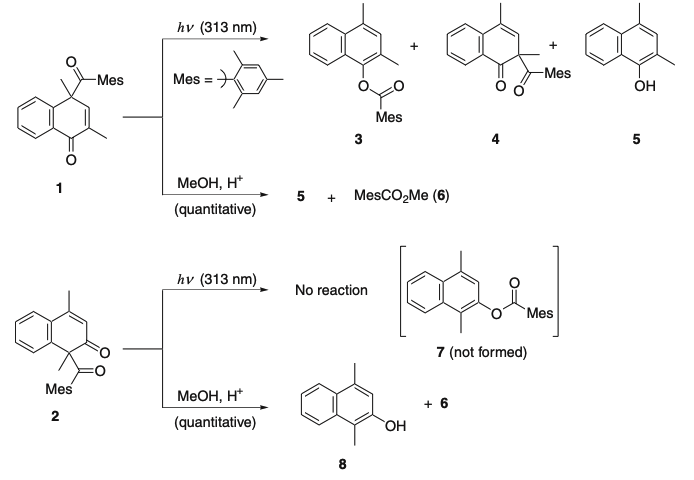
Successful isolation of “ortho” and “para”-acylcyclohexadienones allowed us to comparatively study their ground- and excited-state behavior under a variety of conditions. In neutral solutions, the two isomeric cyclohexdienones showed completely different reactivities for photochemical and thermal reactions, while in acidic methanol both quantitatively afforded the corresponding transesterification product and naphthol. These studies help us understand the detailed photo-Fries rearrangement mechanism, which involves several crucial photochemical and thermal steps.
@article{mori2004remarkable,title={Remarkable differences in photo and thermal (acid-catalyzed) reactivities between ortho-and para-acylcyclohexadienones as essential factors determining the overall efficiency of the photo-Fries rearrangement},author={Mori, Tadashi and Takamoto, Makoto and Saito, Hideaki and Furo, Takahiro and Wada, Takehiko and Inoue, Yoshihisa},journal={Chem. Lett.},volume={33},number={3},pages={256--257},year={2004},publisher={Oxford University Press},doi={10.1246/cl.2004.256},url={https://doi.org/10.1246/cl.2004.256},dimensions={true},tab={paper},}
Chiroptical properties of organic radical cations. The electronic and vibrational circular dichroism spectra of α-tocopherol derivatives and sterically hindered chiral hydroquinone ethers
Tadashi Mori*, Hiroshi Izumi, and Yoshihisa Inoue*
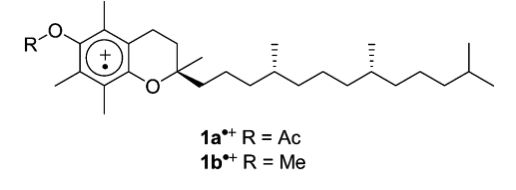
Qualitatively and quantitatively reliable electronic and vibrational circular dichroism (ECD and VCD) spectra of chiral organic radical cations were obtained for the first time with α-tocopherol derivatives and sterically hindered chiral hydroquinone ethers. The isolation and spectral measurements of chiral radical cation salts were made possible by using nitrosonium or antimony derivatives as electron-transfer oxidants, which can cleanly oxidize the substrate donors without giving any byproducts in the sample solution. Such reliable ECD spectra enabled us to fully examine the chiroptical properties of organic radical cations and also compare them with those of the corresponding neutral compounds. The observed VCD spectra of neutral and radical cationic species of chiral hydroquinone ether were nicely simulated by density functional theory (DFT) calculations, from which the relative contribution of each radical cation conformer in solution was evaluated. Thus, the combined synthetic, spectroscopic, and theoretical protocol, composed of chiral modification, clean oxidation to form stable radical cations, ECD/VCD spectral analyses, and DFT calculations, was demonstrated to be a powerful, indispensable tool for elucidating a comprehensive picture of radical cationic species in solution.
@article{mori2004chiroptical,title={Chiroptical properties of organic radical cations. The electronic and vibrational circular dichroism spectra of $\alpha$-tocopherol derivatives and sterically hindered chiral hydroquinone ethers},author={Mori, Tadashi and Izumi, Hiroshi and Inoue, Yoshihisa},journal={J. Phys. Chem. A},volume={108},number={44},pages={9540--9549},year={2004},publisher={ACS Publications},doi={10.1021/jp0463520},url={https://doi.org/10.1021/jp0463520},dimensions={true},tab={paper},}
Pressure control of enantiodifferentiating polar addition of 1, 1-diphenylpropene sensitized by chiral naphthalenecarboxylates
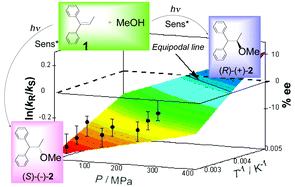
Effects of pressure on the enantiodifferentiating methanol addition to 1,1-diphenylpropene (1) sensitized by chiral naphthalenedicarboxylates (3 and 4) were investigated over 0.1–400 MPa. The logarithm of enantiomeric excess (ee) of photoadduct, i.e. 1,1-diphenyl-2-methoxypropane (2), was a linear function of both pressure (P) and temperature (T); further, the product chirality was switched by P in some cases. From the slope of P − ln(kR/kS) plot, the differential activation volume (ΔΔV‡) was determined for the first time for bimolecular asymmetric photoreactions. The ΔΔV‡ values obtained are mostly larger than those obtained for relevant unimolecular photoreactions, and are a critical function of the nature of the chiral auxiliary and solvent, indicating conformation changes of the intervening diastereomeric exciplex or transition state in different solvents. Indeed, fluorescence spectral examinations of the sensitizer and exciplex under high pressure revealed the existence of exciplexes of variable energy and structure, which may rationalize the different ΔΔV‡ and product ee obtained. A three-dimensional diagram, correlating the ee with P and T, was constructed from the pressure dependence data at different T, from which we may propose an idea of the multidimensional control of asymmetric reaction by the combined use of the entropy-related enviromental factors.
@article{kaneda2004pressure,title={Pressure control of enantiodifferentiating polar addition of 1, 1-diphenylpropene sensitized by chiral naphthalenecarboxylates},author={Kaneda, Masayuki and Nishiyama, Yasuhiro and Asaoka, Sadayuki and Mori, Tadashi and Wada, Takehiko and Inoue, Yoshihisa},journal={Org. Biomol. Chem.},volume={2},number={9},pages={1295--1303},year={2004},publisher={Royal Society of Chemistry},doi={10.1039/b401108b},url={https://doi.org/10.1039/b401108b},dimensions={true},tab={paper},}
Anion Radical (Cation Radical) π-Mer and Dimer Dianion (Dication)