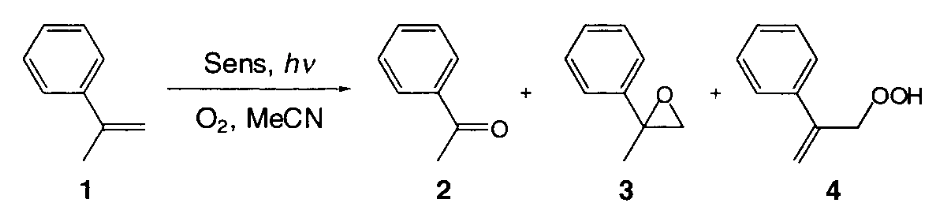
α-Methylstyrene (1) was photooxidized with oxygen in the presence of a series of alkylated dimethoxybenzenes as a sensitizer in acetonitrile, affording the cleaved ketone (2), epoxide (3) as well as a small amount of the ene product (4) in ca. 1:1:0.04 ratio. A non-singlet-oxygen mechanism is proposed, in which an excited sensitizer is quenched by oxygen to produce a sensitizer radical cation and a superoxide ion (O2radical dot−), the former of which oxidizes 1, while O2radical dot− reacts with the resulting 1radical dot+ to give the major oxidation products.
@article{mori2001photoinduced,title={Photoinduced electron transfer oxidation of α-methylstyrene with molecular oxygen sensitized by dimethoxybenzenes: a non-singlet-oxygen mechanism},author={Mori, Tadashi and Takamoto, Makoto and Tate, Yoshimasa and Shinkuma, Junya and Wada, Takehiko and Inoue, Yoshihisa},journal={Tetrahedron Lett.},volume={42},number={13},pages={2505--2508},year={2001},publisher={Elsevier},doi={10.1016/S0040-4039(01)00213-1},url={https://doi.org/10.1016/S0040-4039(01)00213-1},dimensions={true},tab={paper},}
Photoinduced Electron-Transfer Oxidation of Olefins with Molecular Oxygen Sensitized by Tetrasubstituted Dimethoxybenzenes: A Non-Singlet-Oxygen Mechanism
Tadashi Mori*, Makoto Takamoto, Takehiko Wada, and Yoshihisa Inoue*
α-Methylstyrene (1) was photo-oxidized in the presence of a series of alkylated dimethoxybenzenes as sensitizers in an oxygen-saturated MeCN solution to afford the cleaved ketone 2, epoxide 3, as well as a small amount of the ene product 4 in ca. 1: 1:0.04 ratio. The relative rate of conversion was well-correlated with the fluorescence quantum yield of sensitizers. Thus, a non-singlet-oxygen mechanism is proposed, in which an excited sensitizer is quenched by (ground-state) molecular oxygen to produce a sensitizer radical cation and a superoxide ion (O), the former of which oxidizes the substrate, while the latter reacts with the resulting olefin radical cation (1+.) to give the major oxidation products. Photodurability of such electron-donating sensitizers is dramatically improved by substituting four aromatic H-atoms in 1,4-dimethoxybenzene with Me or fused alkyl groups, which provides us with an environmentally friendly, clean method of photochemical functionalization with molecular oxygen, alternative to the ene reaction via singlet oxygenation.
@article{mori2001photoinduced2,title={Photoinduced Electron-Transfer Oxidation of Olefins with Molecular Oxygen Sensitized by Tetrasubstituted Dimethoxybenzenes: A Non-Singlet-Oxygen Mechanism},author={Mori, Tadashi and Takamoto, Makoto and Wada, Takehiko and Inoue, Yoshihisa},journal={Helv. Chim. Acta},volume={84},number={9},pages={2693--2707},year={2001},publisher={Wiley Online Library},doi={10.1002/1522-2675(20010919)84:9<2693::AID-HLCA2693>3.0.CO;2-3},url={https://doi.org/10.1002/1522-2675(20010919)84:9<2693::AID-HLCA2693>3.0.CO;2-3},dimensions={true},tab={paper},}