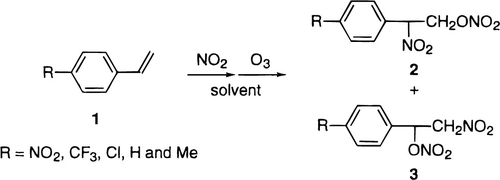
The side-chain nitration of styrene and four para-substituted derivatives 1 with a combination of nitrogen dioxide and ozone has been investigated as part of our continued effort to define the scope of applicability of this new nitration methodology (kyodai nitration). Styrene and derivatives underwent a smooth addition reaction across the olefinic bond in dichloromethane at −20 °C, affording the corresponding isomeric nitro-nitrato adducts 2 and 3 in excellent combined yield. 1H-NMR data were collected for all possible nitro-nitrato adducts of styrene and derivatives. The mechanism of the formation of these addition products is discussed in terms of the reversible addition of nitrogen dioxide to form unstable nitroso-nitrates 9 and 10 followed by rapid oxidation of these to the corresponding nitro-nitrates 2 and 3.
@article{suzuki1997side,title={Side-chain nitration of styrene and para-substituted derivatives with a combination of nitrogen dioxide and ozone},author={Suzuki, Hitomi and Mori, Tadashi},journal={J. Org. Chem.},volume={62},number={19},pages={6498--6502},year={1997},publisher={ACS Publications},doi={10.1021/jo9705024},url={https://doi.org/10.1021/jo9705024},dimensions={true},tab={paper},}
C-Nitration of pyridine by the kyodai-nitration modified by the Bakke procedure. A simple route to 3-nitropyridine and mechanistic aspect of its formation
N-Nitropyridinium nitrate was generated in situ from pyridine, nitrogen dioxide and ozone in an inert organic solvent and subsequently treated with aqueous sodium hydrogen sulfite to afford 3-nitropyridine in good yield, together with sodium pyridine-4-sulfonate as a water-soluble by-product.
@article{suzuki1997c,title={C-Nitration of pyridine by the kyodai-nitration modified by the Bakke procedure. A simple route to 3-nitropyridine and mechanistic aspect of its formation},author={Suzuki, Hitomi and Iwaya, Masao and Mori, Tadashi},journal={Tetrahedron Lett.},volume={38},number={32},pages={5647--5650},year={1997},publisher={Elsevier},doi={10.1016/S0040-4039(97)01229-X},url={https://doi.org/10.1016/S0040-4039(97)01229-X},dimensions={true},tab={paper},}
Direct Oxidation of Methyl Ethers to Carbonyl Compounds with a Combination of Nitrogen Dioxide and Water in the Presence or Absence of Ozone.
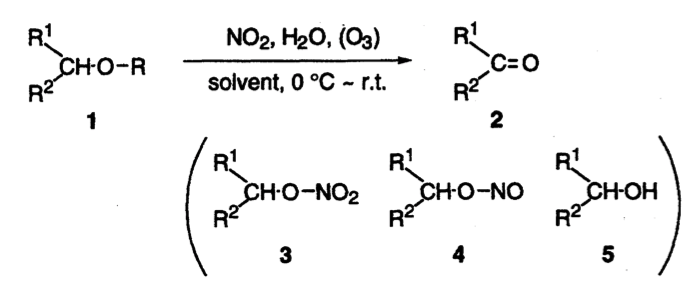
A combination of nitrogen dioxide and water has been found to provide a new agent for the transformation of various alkyl methyl ethers 1 (R = Me) to carbonyl compounds 2 under mild conditions. The oxidation can be achieved successfully in dichloromethane, but hexafluoro-2-propanol was found to be most satisfactory as the solvent. The reaction was generally clean, and simple evaporation gave the expected oxidation product 2 in moderate to good yield. In the presence of ozone, but without water, the similar oxidation was observed only after prolonged reaction time, suggesting that some initial minor reaction with a strong oxidant, possible nitrogen trioxide, afforded an acidic promoter, which then worked as a catalyst similar to that involved in the reaction with a nitrogen dioxide and water system.
@article{suzuki1997direct,title={Direct Oxidation of Methyl Ethers to Carbonyl Compounds with a Combination of Nitrogen Dioxide and Water in the Presence or Absence of Ozone.},author={Suzuki, Hitomi and Takeuchi, Toyomi and Mori, Tadashi},journal={Bull. Chem. Soc. Jpn.},volume={70},number={12},pages={3111--3115},year={1997},publisher={CSJ},doi={10.1246/bcsj.70.3111},url={https://doi.org/10.1246/bcsj.70.3111},dimensions={true},tab={paper},}
Ozone-mediated nitration of bicumene and derivatives with nitrogen dioxide. Preferential mesolytic bond cleavage over nuclear nitration in evidence for the electron transfer nature of the kyodai-nitration of arenes
Hitomi Suzuki* and Tadashi Mori
J. Chem. Soc., Perkin Trans. 2, 1997, 70, 1265–1274.
The ozone-mediated reaction of bicumene and some derivatives 1 with nitrogen dioxide in dichloromethane at low temperatures resulted in the facile cleavage of the central C–C bond to give the corresponding benzyl nitrate and its descendants 4–6. Mesolytic bond cleavage occurred almost exclusively over nuclear substitution at temperatures as low as -20 °C, especially at low concentration (2 × 10⁻³ mol dm-3). This result may be rationalized in terms of initial electron transfer between the aromatic substrate and nitrogen trioxide generated in situ to form the aromatic radical cation, which then undergoes C–C bond scission at the benzylic position. In contrast, bibenzyl 2a is simply nitrated on the aromatic ring under similar conditions, giving the expected nitration products 7 and 8a–c along with a small amount of benzaldehyde 9. Results obtained from semi-empirical calculations and cyclic voltammetry are also in accord with the electron transfer nature of the reaction. The C–Si bond fission of benzyltrimethylsilane, C–C bond fragmentation of cyclic acetals of aromatic carbonyl compounds as well as side-chain reactions of toluene and derivatives, have all previously been observed under certain conditions of the kyodai-nitration and can be understood on a similar basis as described above. The possible involvment of electron transfer processes in aromatic nitration with acetyl nitrate has also been suggested.
@article{suzuki1997ozone,title={Ozone-mediated nitration of bicumene and derivatives with nitrogen dioxide. Preferential mesolytic bond cleavage over nuclear nitration in evidence for the electron transfer nature of the kyodai-nitration of arenes},author={Suzuki, Hitomi and Mori, Tadashi},journal={J. Chem. Soc., Perkin Trans. 2},number={7},pages={1265--1274},year={1997},publisher={Royal Society of Chemistry},doi={10.1039/a700326i},url={https://doi.org/10.1039/a700326i},dimensions={true},tab={paper},}