Ozone-mediated nitration of phenylalkyl ethers, phenylacetic esters, and related compounds with nitrogen dioxide. The highest ortho substitution observed in the electrophilic nitration of arenes
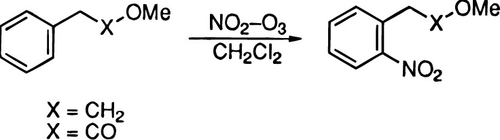
By the combined action of ozonized oxygen and nitrogen dioxide (the kyodai-nitration), the title compounds were smoothly nitrated in dichloromethane at subzero degrees with high ortho positional selectivity. Although the conventional nitration of phenylacetic acid and esters mainly produces m- and p-nitro derivatives, the present nitration offers a simple high-yield synthesis of o-nitro derivatives which are important as precursor in organic synthesis. The proportions of the ortho isomer in the nitration products from methyl 2-phenylethyl ether and methyl phenylacetate were 71 and 88%, respectively, the latter value being the highest ortho isomer proportion so far observed in the electrophilic aromatic nitration. The observed high ortho selectivity has been rationalized in terms of radical cation intermediate and six-membered cyclic transition state.
@article{suzuki1996ozone,title={Ozone-mediated nitration of phenylalkyl ethers, phenylacetic esters, and related compounds with nitrogen dioxide. The highest ortho substitution observed in the electrophilic nitration of arenes},author={Suzuki, Hitomi and Takeuchi, Toyomi and Mori, Tadashi},journal={J. Org. Chem.},volume={61},number={17},pages={5944--5947},year={1996},publisher={ACS Publications},doi={10.1021/jo9606867},url={https://doi.org/10.1021/jo9606867},dimensions={true},tab={paper},}
Preference of the mesolytic cleavage over the nuclear substitution observed in the ozone-mediated nitration of bicumene with nitrogen dioxide. Implication to the electron transfer nature of the Kyodai-nitration of arenes
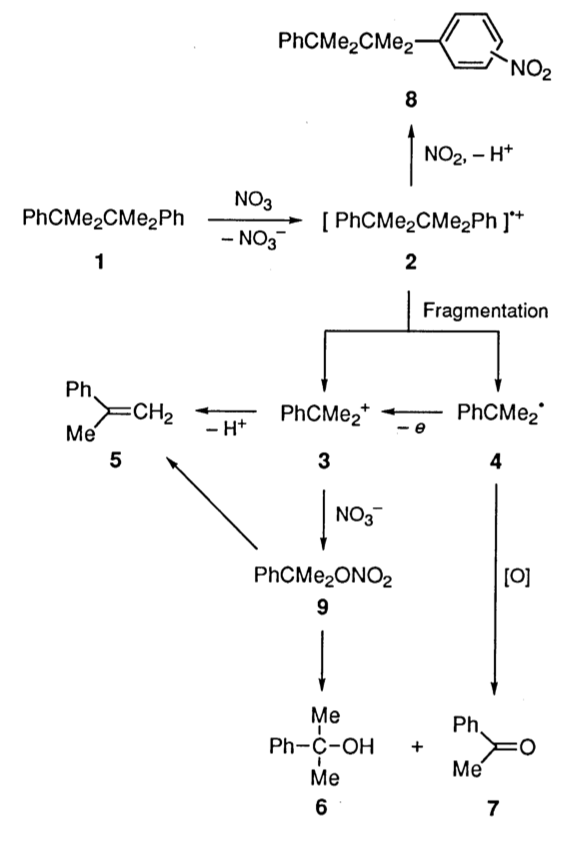
Ozone-mediated reaction of bicumene with nitrogen dioxide in dichloromethane at low temperature results in almost complete mesolytic cleavage of the hydrocarbon, accompanied by little or no nuclear nitration, in accordance with operation of the electron transfer process involving the nitrogen trioxide as initial electrophile.
@article{suzuki1996preference,title={Preference of the mesolytic cleavage over the nuclear substitution observed in the ozone-mediated nitration of bicumene with nitrogen dioxide. Implication to the electron transfer nature of the Kyodai-nitration of arenes},author={Suzuki, Hitomi and Mori, Tadashi},journal={Chem. Lett.},volume={25},number={8},pages={647--648},year={1996},publisher={Oxford University Press},doi={10.1246/cl.1996.647},url={https://doi.org/10.1246/cl.1996.647},dimensions={true},tab={paper},}
Iron (III)-catalysed nitration of non-activated and moderately activated arenes with nitrogen dioxide–molecular oxygen under neutral conditions
Hitomi Suzuki*, Shuji Yonezawa, Nobuaki Nonoyama, and Tadashi Mori
J. Chem. Soc., Perkin Trans. 1, 1996, 25, 2385–2389.
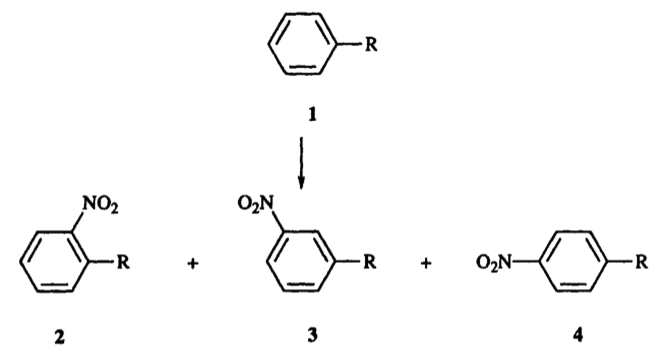
In the presence of molecular oxygen and a catalytic amount of tris(pentane-2,4-dionato)iron(III), non-activated and moderately activated arenes, which include alkylbenzenes, halogenobenzenes, phenolic ethers, naphthalene and derivatives, can be nitrated with nitrogen dioxide at ice-bath temperature or below to give the corresponding nitro derivatives in fair to good yields. An electron-transfer mechanism has been proposed, where an activated NO2-FeIII complex plays a key role in the cyclic process for converting arenes into nitroarenes.
@article{suzuki1996iron,title={Iron (III)-catalysed nitration of non-activated and moderately activated arenes with nitrogen dioxide--molecular oxygen under neutral conditions},author={Suzuki, Hitomi and Yonezawa, Shuji and Nonoyama, Nobuaki and Mori, Tadashi},journal={J. Chem. Soc., Perkin Trans. 1},number={19},pages={2385--2389},year={1996},publisher={The Royal Society of Chemistry},doi={10.1039/P19960002385},url={https://doi.org/10.1039/P19960002385},dimensions={true},tab={paper},}
Ozone-mediated nitration of naphthalene and some methyl derivatives with nitrogen dioxide. Remarkable enhancement of the 1-nitro/2-nitro isomer ratio and mechanistic implications
Hitomi Suzuki and Tadashi Mori
J. Chem. Soc., Perkin Trans. 2, 1996, 25, 677–683.
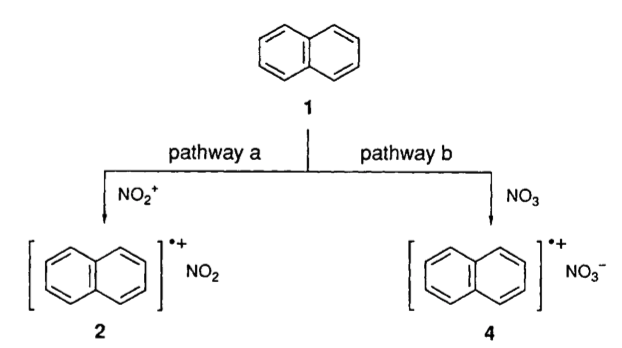
Naphthalene, 1- and 2-methylnaphthalenes were smoothly nitrated with nitrogen dioxide at low temperatures in the presence of ozone to afford the corresponding vitro derivatives in high yields. For naphthalene, the 1-nitro/2-nitro isomer ratios were remarkably high, mostly ranging from 35 to 70. 1,4-Dimethylnaphthalene suffered extensive side-chain substitution under similar conditions. The enhanced regioselectivity as compared with conventional nitration has been interpreted in terms of the electron transfer mechanism involving the nitrogen trioxide as the initial electrophile.
@article{suzuki1996ozone2,title={Ozone-mediated nitration of naphthalene and some methyl derivatives with nitrogen dioxide. Remarkable enhancement of the 1-nitro/2-nitro isomer ratio and mechanistic implications},author={Suzuki, Hitomi and Mori, Tadashi},journal={J. Chem. Soc., Perkin Trans. 2},number={4},pages={677--683},year={1996},publisher={Royal Society of Chemistry},doi={10.1039/P29960000677},url={https://doi.org/10.1039/P29960000677},dimensions={true},tab={paper},}
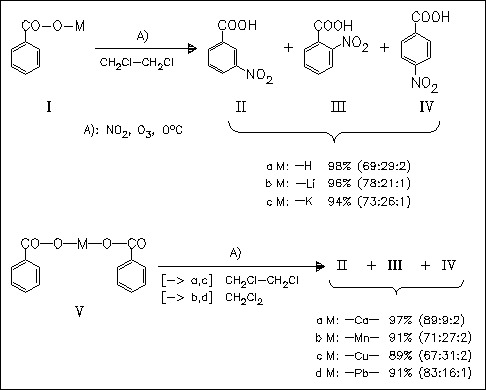
Solid-Phase Nitration of Salts of Aromatic Carboxylic Acids Using Nitrogen Dioxide in the Presence of Ozone. Controlling the Reaction Rate and the Isomer Ratio Using Metal Ions
Hitomi Suzuki*, Nobuaki Nonoyama, J Tomaru, and Tadashi Mori
@article{suzuki1996solid,title={Solid-Phase Nitration of Salts of Aromatic Carboxylic Acids Using Nitrogen Dioxide in the Presence of Ozone. Controlling the Reaction Rate and the Isomer Ratio Using Metal Ions},author={Suzuki, Hitomi and Nonoyama, Nobuaki and Tomaru, J and Mori, Tadashi},journal={Russ. J. Org. Chem.},volume={32},issue={2},pages={248--251},year={1996},publisher={Kluwer Academic Plenum Publisher},doi={10.1002/chin.199644066},url={https://doi.org/10.1002/chin.199644066},dimensions={true},tab={paper},}