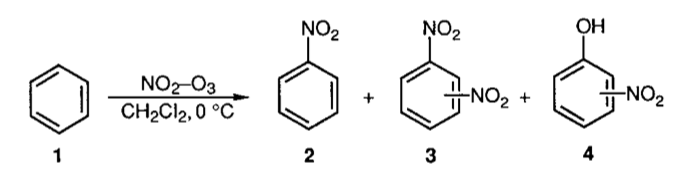
Unusual isomer distribution of dinitrobenzenes and nitrophenols formed as side products during the ozone-mediated nitration of benzene with nitrogen dioxide. Further evidence for the alternative mechanism of electrophilic nitration of arenes
Dinitrobenzenes and nitrophenols formed as side products in the title reaction leading to nitrobenzene show an isomer distribution that is significantly different from those observed in the conventional nitration using nitric acid or nitric acid–sulfuric acid, suggesting the operation of a non-classical nitration mechanism involving nitrogen trioxide as the initial electrophile.
@article{suzuki1995unusual,title={Unusual isomer distribution of dinitrobenzenes and nitrophenols formed as side products during the ozone-mediated nitration of benzene with nitrogen dioxide. Further evidence for the alternative mechanism of electrophilic nitration of arenes},author={Suzuki, Hitomi and Mori, Tadashi},journal={J. Chem. Soc. Perkin Trans. 2},number={1},pages={41--44},year={1995},publisher={The Royal Society of Chemistry},doi={10.1039/P29950000041},url={https://doi.org/10.1039/P29950000041},dimensions={true},tab={paper},}
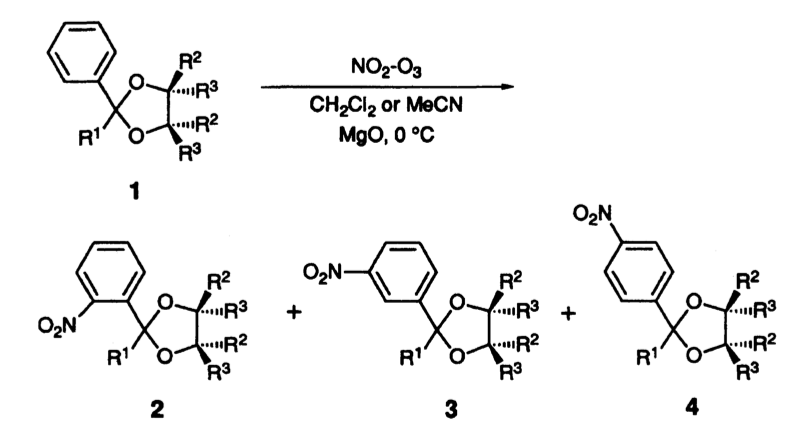
Aromatic Nitration under Neutral Conditions Using Nitrogen Dioxide and Ozonne as the Nitrating Agent. Application to Aromatic Acetals and Acylal.
Cyclic acetals derived from aromatic carbonyl compounds can be nitrated smoothly with nitrogen dioxide in ice-cooled dichloromethane or acetonitrile in the presence of ozone and magnesium oxide to give ortho- and para-nitro derivatives as the major product in good combined yields, the acetal ring as a protective group remaining almost intact. An acylal derived from benzaldehyde similarly undergoes nitration on the aromatic ring to give an isomeric mixture of three nitro compounds, in which the ortho and meta isomers predominate, while aromatic orthoesters are rapidly decomposed to give simply the parent esters. Ring nitration under neutral conditions has been interpreted in terms of a nonclassical mechanism, in which nitrogen trioxide is involved as the initial electrophile.
@article{suzuki1995aromatic,title={Aromatic Nitration under Neutral Conditions Using Nitrogen Dioxide and Ozonne as the Nitrating Agent. Application to Aromatic Acetals and Acylal.},author={Suzuki, Hitomi and Yonezawa, Shuji and Mori, Tadashi},journal={Bull. Chem. Soc. J.},volume={68},number={6},pages={1535--1544},year={1995},publisher={CSJ},doi={10.1246/bcsj.68.1535},url={https://doi.org/10.1246/bcsj.68.1535},dimensions={true},tab={paper},}
Ozone-mediated Nitration of Aromatic Compounds with Lower Oxides of Nitrogen (The Kyodai-Nitration)
A novel non-acid methodology for the preparative nitration of aromatic compounds with the lower oxides of nitrogen using a combination of ozonized oxygen or air and some third substance as the promoter is described. The reaction, referred to as the kyodai-nitration, is now subject to industrially based research as the promising pollution-free and energy-saving substitute for the century-old, yet currently ongoing commercial process based on the use of nitric acid-sulfuric acid.
@article{mori1995ozone,title={Ozone-mediated Nitration of Aromatic Compounds with Lower Oxides of Nitrogen (The Kyodai-Nitration)},author={Mori, Tadashi and Suzuki, Hitomi},journal={Synlett},number={5},pages={383--392},year={1995},publisher={Thieme},doi={10.1055/s-1995-4979},url={https://doi.org/10.1055/s-1995-4979},dimensions={true},tab={review},}
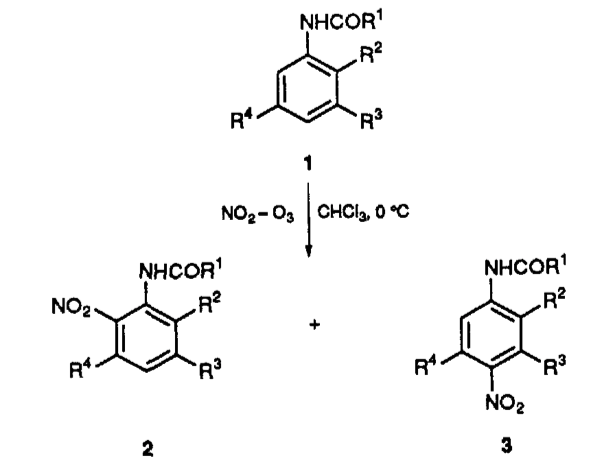
Ozone-mediated reaction of anilides and phenyl esters with nitrogen dioxide: enhanced ortho-reactivity and mechanistic implications
Hitomi Suzuki*, Atsuo Tatsumi, Taro Ishibashi, and Tadashi Mori
J. Chem. Soc., Perkin Trans. 1, 1995, 68, 339–343.
In the presence of ozone, anilides 1 can be nitrated rapidly with nitrogen dioxide in chloroform at 0 °C to give a high proportion of ortho-nitro derivatives (ortho : para= 1.2–4.4) in good yields. The phenyl esters 15 can be similarly nitrated on the aromatic ring without significant cleavage of the ester bond, giving a mixture of isomeric nitro derivatives in which the ortho-isomer predominates (ortho : para= 1.1–1.5). The origin of the enhanced ortho reactivity is discussed in terms of an electron-transfer process involving the nitrogen trioxide as initial electrophile.
@article{suzuki1995ozone,title={Ozone-mediated reaction of anilides and phenyl esters with nitrogen dioxide: enhanced ortho-reactivity and mechanistic implications},author={Suzuki, Hitomi and Tatsumi, Atsuo and Ishibashi, Taro and Mori, Tadashi},journal={J. Chem. Soc., Perkin Trans. 1},number={4},pages={339--343},year={1995},publisher={The Royal Society of Chemistry},doi={10.1039/P19950000339},url={https://doi.org/10.1039/P19950000339},dimensions={true},tab={paper},}
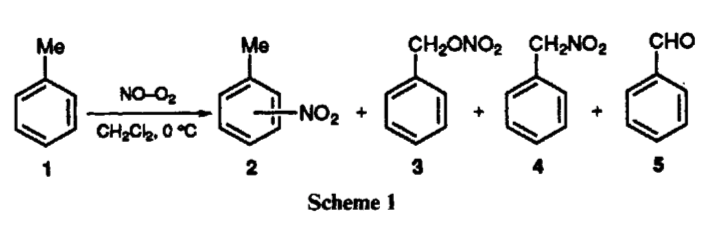
Nitration of nonactivated arenes with a ternary system NO–NO2–O2. Mechanistic implications of the Kyodai-nitration
Hitomi Suzuki* and Tadashi Mori
J. Chem. Soc., Perkin Trans. 1, 1995, 68, 291–293.
The ternary mixture NO–NO2–O2 has been found to be more effective than the binary mixture NO2–O2 as a nitrating agent for nonactivated arenes, such as toluene and chlorobenzene; the results may be rationalized in terms of an initial electron transfer mechanism in which nitrogen trioxide, formed from nitrogen monoxide and dioxygen, oxidizes the arene to its radical cation.
@article{suzuki1995nitration,title={Nitration of nonactivated arenes with a ternary system NO--NO2--O2. Mechanistic implications of the Kyodai-nitration},author={Suzuki, Hitomi and Mori, Tadashi},journal={J. Chem. Soc., Perkin Trans. 1},number={4},pages={291--293},year={1995},publisher={The Royal Society of Chemistry},doi={10.1039/P19950000291},url={https://doi.org/10.1039/P19950000291},dimensions={true},tab={paper},}
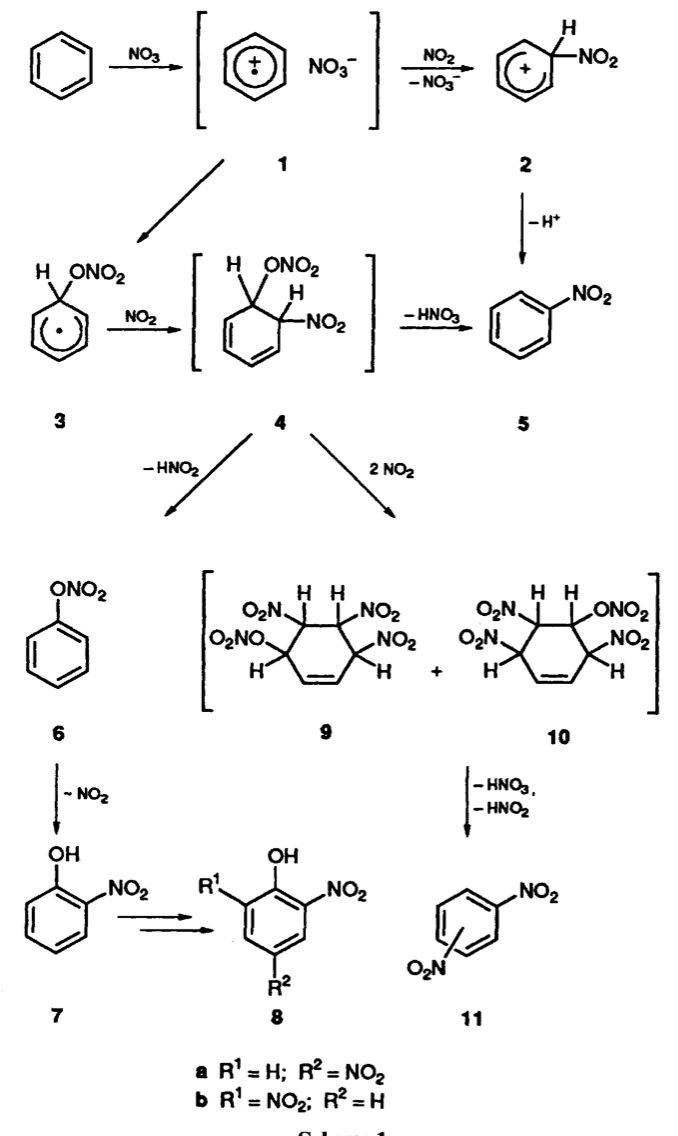 Unusual isomer distribution of dinitrobenzenes and nitrophenols formed as side products during the ozone-mediated nitration of benzene with nitrogen dioxide. Further evidence for the alternative mechanism of electrophilic nitration of arenesJ. Chem. Soc. Perkin Trans. 2, 1995, 41–44.