Ozone-mediated reaction of aromatic acetals and acylal with nitrogen dioxide: a novel methodology for the nuclear nitration of acid-sensitive aromatic compounds under neutral conditions
Hitomi Suzuki*, Shuji Yonezawa, Tadashi Mori, and Koichi Maeda
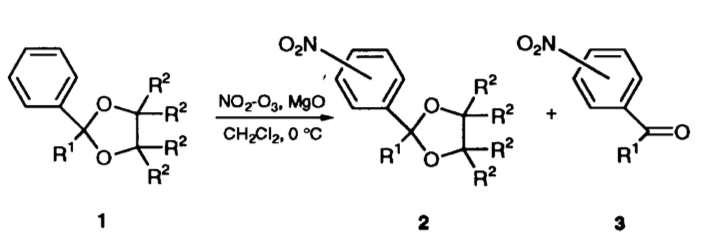
Cyclic acetals 1c–e and 1g can be nitrated smoothly with nitrogen dioxide in ice-cooled dichloromethane in the presence of ozone and magnesium oxide to give mainly ortho- and para- nitro derivatives in good combined yields, the acetal protective group remaining almost intact; acylal 6 is similarly nitrated on the aromatic ring to give a mixture of isomeric nitro derivatives 7, in which the ortho and meta isomers predominate.
@article{suzuki1994ozone,title={Ozone-mediated reaction of aromatic acetals and acylal with nitrogen dioxide: a novel methodology for the nuclear nitration of acid-sensitive aromatic compounds under neutral conditions},author={Suzuki, Hitomi and Yonezawa, Shuji and Mori, Tadashi and Maeda, Koichi},journal={J. Chem. Soc., Perkin Trans. 1},number={11},pages={1367--1369},year={1994},publisher={The Royal Society of Chemistry},doi={10.1039/P19940001367},url={https://doi.org/10.1039/P19940001367},dimensions={true},tab={paper},}
Ozone-mediated nitratrion of arenes with nitrogen dioxide: change-over of the orienting influences of alkyl, alkoxyl and halogen substituent groups from meta to ortho-para dominance
Hitomi Suzuki*, Takashi Murashima, and Tadashi Mori
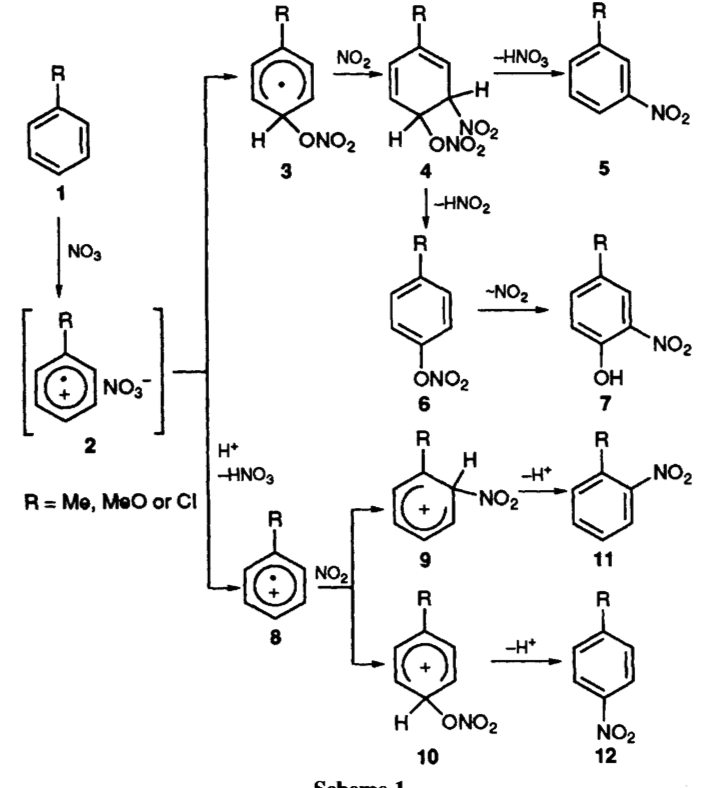
In ozone-mediated nitration of toluene, anisole and chlorobenzene with nitrogen dioxide, the initial products have been found to be composed mainly of the meta-nitro derivatives, but the isomer distributions are rapidly replaced by the ortho-para isomers as the reaction proceeds, sugesting the operation of the electron transfer mechanism involving the nitrogen trioxide as initial electrophile.
@article{suzuki1994ozone2,title={Ozone-mediated nitratrion of arenes with nitrogen dioxide: change-over of the orienting influences of alkyl, alkoxyl and halogen substituent groups from meta to ortho-para dominance},author={Suzuki, Hitomi and Murashima, Takashi and Mori, Tadashi},journal={J. Chem. Soc., Chem. Commun.},number={12},pages={1443--1444},year={1994},publisher={The Royal Society of Chemistry},doi={10.1039/C39940001443},url={https://doi.org/10.1039/C39940001443},dimensions={true},tab={paper},}
Ozone-mediated reaction of polychlorobenzenes and some related halogeno compounds with nitrogen dioxide: a novel non-acid methodology for the selective mononitration of moderately deactivated aromatic systems
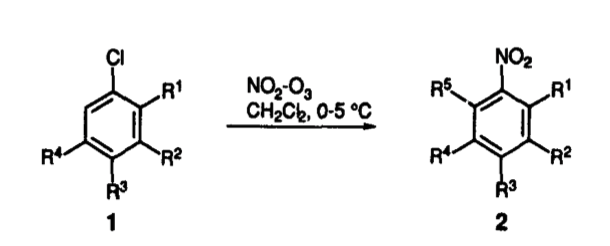
In the presence of ozone and preferably methanesulfonic acid as catalyst, polychlorobenzenes undergo selevtive mononitration with nitrogen dioxide at low temperatures, giving the corresponding polychloronitrobenzenes, in most cases in nearly quantitative yields.
@article{suzuki1994ozone3,title={Ozone-mediated reaction of polychlorobenzenes and some related halogeno compounds with nitrogen dioxide: a novel non-acid methodology for the selective mononitration of moderately deactivated aromatic systems},author={Suzuki, Hitomi and Mori, Tadashi and Maeda, Koichi},journal={Synthesis},volume={1994},number={08},pages={841--845},year={1994},publisher={Georg Thieme Verlag},doi={10.1055/s-1994-25586},url={https://doi.org/10.1055/s-1994-25586},dimensions={true},tab={paper},}
Ozone-mediated nitration of chloro-and bromo-benzenes and some methyl derivatives with nitrogen dioxide. High ortho-directing trends of the chlorine and bromine substituents
Hitomi Suzuki* and Tadashi Mori
J. Chem. Soc., Perkin Trans. 2, 1994, 1994, 479–484.
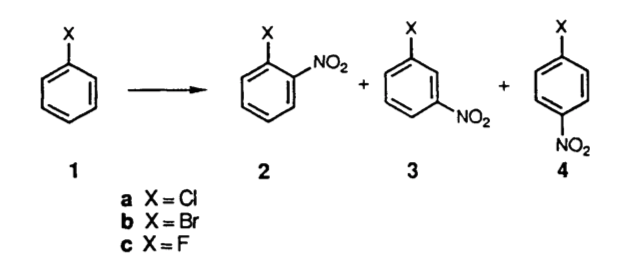
In the presence of ozone, chloro- and bromo-benzenes are nitrated smoothly with nitrogen dioxide at low temperatures, giving a mixture of the corresponding nitro derivatives in nearly quantitative yield. The nitration products are generally ortho-rich as compared with those obtained by the conventional procedures based on the use of nitric acid or mixed acid. Interestingly, the ortho : para isomer ratios of the products can be reversed from ortho-rich (o : p= 1.14 and 1.09) to para-predominant (o : p= 0.45 and 0.68) simply by altering the initial concentration of the substrate. This enigmatic phenomenon has been interpreted in terms of the equilibrium between the monomer and the dimer forms of the cation radical derived from a halogenobenzene and the difference in their relative reactivity toward nitrogen dioxide. Similar preference for substitution ortho to the halogen substituent has been observed with 4-chloro- and 4-bromo-toluenes, which concurrently suffer extensive ipso attack by the present reagent system, leading to the formation of 4-methyl-2-nitrophenol as a common side product.
@article{suzuki1994ozone4,title={Ozone-mediated nitration of chloro-and bromo-benzenes and some methyl derivatives with nitrogen dioxide. High ortho-directing trends of the chlorine and bromine substituents},author={Suzuki, Hitomi and Mori, Tadashi},journal={J. Chem. Soc., Perkin Trans. 2},number={3},pages={479--484},year={1994},publisher={The Royal Society of Chemistry},doi={10.1039/P29940000479},url={https://doi.org/10.1039/P29940000479},dimensions={true},tab={paper},}